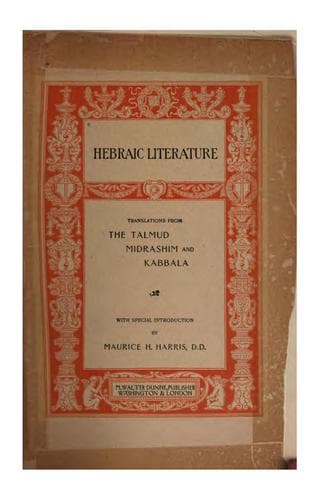
Hebraic Literature; Translations from the Talmud, Midrashim and Kabbala
Religion
Hebraic Literature; Translations from the Talmud, Midrashim and Kabbala
Hebrew literature -- Translations into English
Through this cause was Cæsar sent to capture Jerusalem, and for two
years he besieged the city. Four wealthy citizens of Jerusalem had
stored up enough food to last the inhabitants a much longer time than
this, but the people being anxious to fight with the Romans, destroyed
the storehouses and brought dire famine upon the city.
A certain noble lady, Miriam, the daughter of Baythus, sent her servant
to purchase some flour for household use. The servant found that all the
flour had been sold, but there was still some meal which he might have
purchased. Hurrying home, however, to learn his mistress's wishes in
regard to this, he discovered on his return that this too had been sold,
and he could obtain nothing save some coarse barley meal. Not wishing to
purchase this without orders he returned home again, but when he
returned to the storehouse to secure the barley meal, that was gone
also. Then his mistress started out herself to purchase food, but she
could find nothing. Suffering from the pangs of hunger she picked from
the street the skin of a fig and ate it; this sickened her and she died.
But previous to her death she cast all her gold and silver into the
street, saying, "What use is this wealth to me when I can obtain no food
for it?" Thus were the words of Ezekiel fulfilled:--
"Their silver shall they cast into the streets."
After the destruction of the storehouses, Rabbi Jochanan in walking
through the city saw the populace boiling straw in water and drinking of
the same for sustenance. "Ah, woe is me for this calamity!" he
exclaimed; "how can such a people strive against a mighty host?" He
applied to Ben Batiach, his nephew, one of the chiefs of the city, for
permission to leave Jerusalem. But Ben Batiach replied, "It may not be;
no living body may leave the city." "Take me out then as a corpse,"
entreated Jochanan. Ben Batiach assented to this, and Jochanan was
placed in a coffin and carried through the gates of the city; Rabbi
Eleazer, Rabbi Joshua, and Ben Batiach acting as pall-bearers. The
coffin was placed in a cave, and after they had all returned to their
homes Jochanan arose from the coffin and made his way to the enemy's
camp. He obtained from the commander permission to establish an academy
in Jabna with Rabbon Gamliel as the principal.
Titus soon captured the city, killed many of the people, and sent the
others into exile. He entered the Temple, even in the Most Holy, and cut
down the veil which separated it from the less sacred precincts. He
seized the holy vessels, and sent them to Rome.
From this history of Kamtzah and Bar Kamtzah we should learn to be
careful of offending our neighbors, when in so slight a cause such great
results may originate. Our Rabbis have said that he who causes his
neighbor to blush through an insult, should be compared to the one who
sheds blood.
* * * * *
Public-domain text, read in full here on John Shaqi.
Reviews
Reviews
No reviews yet
Be the first to share your thoughts on this work.
Elsewhere in the archive
Join the Discussion
Join the discussion
Sign in to leave a comment or review.
Sign InorCreate an account