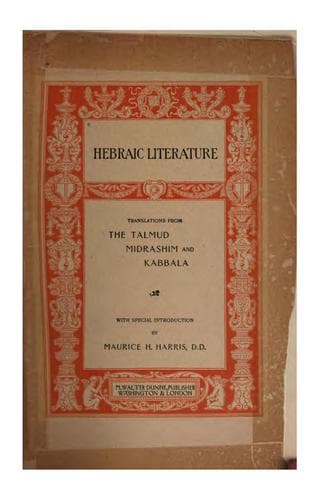
Hebraic Literature; Translations from the Talmud, Midrashim and Kabbala
Religion
Hebraic Literature; Translations from the Talmud, Midrashim and Kabbala
Hebrew literature -- Translations into English
Moses Maimonides, one of the greatest of Jewish commentators, and a
descendant of Rabbi Judah, the compiler of the Mishna, was born in the
city of Cordova, Spain, March 30, 1135. His father was somewhat advanced
in life when he married, and it is said that he entered into the
conjugal state through having dreamed several successive times that he
was wedded to the daughter of a butcher in his neighborhood; the lady
whom he did actually marry.
Moses was the only child of this lady, who died shortly after his birth.
His father lamented her demise for about a year, and then married again,
several children being the result of this second union.
Moses displayed no love for study in his youth; a fact which grieved his
father much. All efforts to induce him to become more studious failed;
his brothers called him "the butcher's boy," as a term of reproach for
his dullness; and finally, in anger, his father drove him from his home.
While traveling, entirely friendless, Moses fell in with a learned
Rabbi, and admired his wisdom and knowledge so much that he resolved to
study zealously and emulate such attainments.
Many years after this a new preacher was announced to lecture in the
synagogue, at Cordova, upon a designated Sabbath. Numerous rumors of his
wonderful learning and eloquence were rife, and all were anxious to hear
him. In matter, delivery, earnestness, and effect, the sermon excelled
all that the people had before listened to, and to the amazement of
Maimonides the elder, and his sons, they recognized in the man all were
eager to honor, their outcast relative.
The first commentary of Maimonides is upon the Mishna, and it concludes
with these words:--
"I, Moses, the son of Maymon, commenced this commentary when
twenty-three years of age. I have finished it at the age of thirty in
the land of Egypt."
Maimonides fled from Spain to Cairo, in Egypt, from fanaticism and
persecution. There he studied the Greek and Chaldaic languages, becoming
master of both after seven years' attention. His fame spread through the
country. His scientific standing and his general knowledge were
universally recognized, and his books were not only valued by his
brethren in faith, but by all the cultured and enlightened of his day.
It is said that the king of Egypt appointed him as one of his staff of
physicians. The enlightened men of the kingdom were divided into seven
grades, each grade occupying a corresponding position near the throne of
the king on state occasions. The monarch considered Maimonides so much
superior to the others that he made for him a special position. This,
Moses, a modest man, declined. The other physicians, however, were
jealous of his high standing, and being unable to injure him openly,
they endeavored to accomplish his ruin in a secret manner.
Public-domain text, read in full here on John Shaqi.
Reviews
Reviews
No reviews yet
Be the first to share your thoughts on this work.
Elsewhere in the archive
Join the Discussion
Join the discussion
Sign in to leave a comment or review.
Sign InorCreate an account