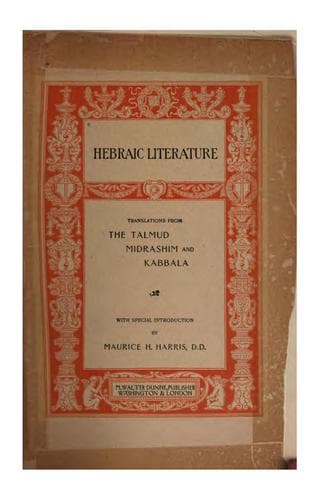
Hebraic Literature; Translations from the Talmud, Midrashim and Kabbala
Religion
Hebraic Literature; Translations from the Talmud, Midrashim and Kabbala
Hebrew literature -- Translations into English
The king was taken very sick, and Maimonides attended him. Taking
advantage of this, the physicians put poison in the draught which Moses
had prepared for him, and then informed the king that the latter
designed his death. To prove their words, they gave some of the mixture
to a dog, and the animal died.
The king was grieved and surprised, and Maimonides, struck dumb with
amazement, was unable to say a word.
"Death is the penalty for one who attempts to assassinate his ruler,"
said the king. "Choose now the mode of thy punishment."
Moses asked for three days for consideration, which the king granted.
During this time he prepared a certain mixture, and instructed his
pupils to have it ready and apply it according to his directions, when
he should be brought home senseless. He then appeared before the king,
and desired to have his veins opened. The vital artery was missed, as he
had anticipated, and the result was as he had foreseen. After his
recovery, he fled from Egypt, taking refuge in a cave, where he wrote
his _Yad Hazakah_ (the "Strong Hand"), consisting of fourteen divisions,
typified by the word _Yad_, which also means fourteen.
Maimonides simplified the Talmudical rules and traditions, making them
clear to the comprehension of all. He was the author of an exhaustive
work, entitled, _Mishne Torah_, the "Second Law," which was eagerly
copied and extensively disseminated. He also wrote many philosophical
treatises leveled against atheism, and designed to prove that God
produced the world from naught, and at the age of fifty gave to the
world his great work, _Moreh Nebuchim_ ("Guide of the Perplexed"), to
which Rabbi Judah Charizi added an appendix.
Maimonides died at the age of seventy years, and his remains were
interred at Cairo, Egypt. Both Jews and Gentiles mourned his loss. The
lamentation in Jerusalem was intense, a fast was declared, the
synagogues were opened, and a portion of the law (Levit. 25:12 to end),
and the fifth chapter of Samuel 1, were made parts of the service of the
day.
* * * * *
During the reign of one of the bishops in Metz, there lived a Jew in
that city, who was called Rabbi Amnon. He was of illustrious family, of
great personal merit, rich and respected by the Bishop and the people.
The Bishop frequently pressed him to abjure Judaism and embrace
Christianity, but without the slightest avail. It happened, however,
upon a certain day, being more closely pressed than usual, and somewhat
anxious to be rid of the Bishop's importunities, he said hastily, "I
will consider the subject, and give thee an answer in three days."
Public-domain text, read in full here on John Shaqi.
Reviews
Reviews
No reviews yet
Be the first to share your thoughts on this work.
Elsewhere in the archive
Join the Discussion
Join the discussion
Sign in to leave a comment or review.
Sign InorCreate an account