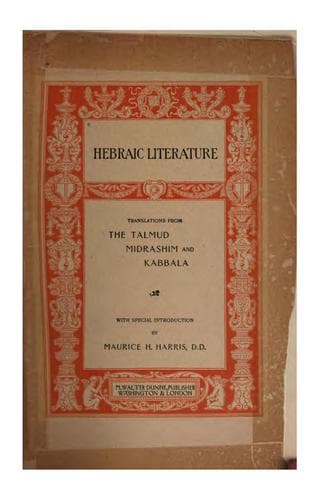
Hebraic Literature; Translations from the Talmud, Midrashim and Kabbala
Religion
Hebraic Literature; Translations from the Talmud, Midrashim and Kabbala
Hebrew literature -- Translations into English
As soon as he had left the Bishop's presence, however, his heart smote
him, and an unquiet conscience blamed him for admitting, even in this
manner, a doubt of the true faith. He reached home overwhelmed with
grief; meat was set before him, but he refused to eat; and when his
friends visited him and ascertained the cause of his low spirits, he
refused their proffered consolation, saying, "I shall go down mourning
to the grave for these words." On the third day, while he was still
lamenting his imprudent concession, the Bishop sent for him, but he
refused to answer the call.
Having refused several of the Bishop's messengers, they were finally
ordered to seize him, and bring him by force before the prelate.
"Amnon," said the Bishop, "why didst thou not come to me, according to
thy promise, to inform me of thy decision in regard to my request?"
"Let me," answered Amnon, "pronounce my own doom for this neglect. Let
my tongue, which uttered those hasty, doubting words, be cut out; a lie
I uttered, for I never intended to consider the proposition."
"Nay," said the Bishop, "I will not cut out thy tongue, but thy feet
which refused to come to me, shall be cut off, and the other parts of
thy obstinate body shall be also punished and tormented."
Under the Bishop's eye and order, the toes and thumbs of Rabbi Amnon
were then cut off, and after having been severely tortured, he was sent
home in a carriage, his mangled members beside him.
Rabbi Amnon bore all this with the greatest resignation, firmly hoping
and trusting that this earthly torment would plead his pardon with God.
His life after this was of course to be measured only by days. The Feast
of the New Year came round, while he was living, and he desired to be
carried to the synagogue. He was conveyed to the house of God, and
during the service he requested to be allowed to utter a prayer. The
words which proved to be his last were as follows:--
"I will declare the mighty holiness of this day, for it is awful and
tremendous. Thy kingdom is exalted thereon; Thy throne is established in
mercy, and upon it Thou dost rest in truth. Thou art the Judge, who
chastiseth, and from Thee naught may be concealed. Thou bearest witness,
writest, sealest, recordest, and rememberest all things, aye, those
which we imagine long buried in the past. The Book of Records thou
openest; the great _shophar_ (cornet) is sounded; even the angels are
terrified, and they cry aloud, 'The Day of Judgment dawns upon us,' for
in judgment they, the angels, are not faultless.
"All who have entered the world pass before Thee. Even as the shepherd
causes the flock he numbers to pass under his crook, so Thou, O Lord,
causest every living soul to pass before Thee. Thou numberest, Thou
visitest; appointing the limitations of every creature, Thy judgment and
Thy sentence.
Public-domain text, read in full here on John Shaqi.
Reviews
Reviews
No reviews yet
Be the first to share your thoughts on this work.
Elsewhere in the archive
Join the Discussion
Join the discussion
Sign in to leave a comment or review.
Sign InorCreate an account