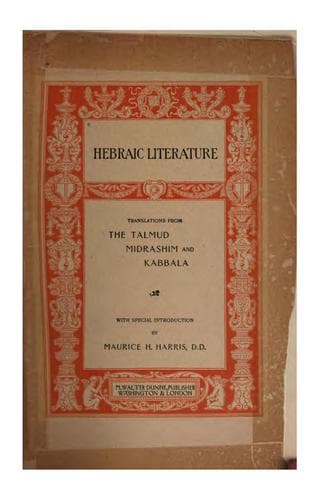
Hebraic Literature; Translations from the Talmud, Midrashim and Kabbala
Religion
Hebraic Literature; Translations from the Talmud, Midrashim and Kabbala
Hebrew literature -- Translations into English
This festival is observed for eight days during the ninth month _Kislev_
(December), and commemorates the dedication of the Temple after it had
been defiled by Antiochus Epiphanes, whose armies were overthrown by the
valiant Maccabees, Hashmoneans.
The Most Holy One has frequently wrought wonders in behalf of his
children in their hour of need, and thereby displayed His supreme power
to the nations of the world. These should prevent man from growing
infidel and ascribing all happiness to the course of nature. The God who
created the world from naught, may change at His will the nature which
He established. When the Hashmoneans gained, with the aid of God, their
great victory, and restored peace and harmony to their land, their first
act was to cleanse and dedicate the Temple, which had been defiled, and
on the twenty-fifth day of _Kislev_, in obedience to the teachings of
the Rabbis, we inaugurate the "Dedication Feast" by lighting the lamps
or candles prepared expressly for this occasion. The first night we
light one, and then an additional one each succeeding night of its
continuance. We also celebrate it by hymns of thanksgiving and
hallelujahs.
This feast is foreshadowed in the Book of Numbers. When Aaron observed
the offerings of the princes of each of the tribes and their great
liberality, he was conscious of a feeling of regret, because he and his
tribe were unable to join with them. But these words were spoken to
comfort him, "Aaron, thy merit is greater than theirs, for thou lightest
and fixest the holy lamps."
When were these words spoken?
When he was charged with the blessing to be found in Numbers 6:23, as
will be found in the Book of Maccabees in the Apocrypha.
The Lord said unto Moses, "Thus say unto Aaron. In the generations to
come, there will be another dedication and lighting of the lamps, and
through thy descendants shall the service be performed. Miracles and
wonders will accompany this dedication. Fear not for the greatness of
the princes of thy tribe; during the existence of the Temple thou shalt
sacrifice, but the lighting of the lamps shall be forever, and the
blessing with which I have charged thee to bless the people shall also
exist forever. Through the destruction of the Temple the sacrifices will
be abolished, but the lighting of the dedication of the Hashmoneans will
never cease."
The Rabbis have ordained this celebration by lighting of lamps, to make
God's miracle known to all coming generations, and it is our duty to
light the same in the synagogues and in our homes.
Although the Lord afflicted Israel on account of iniquities, He still
showed mercy, and allowed not a complete destruction, and to this
festival do the Rabbis again apply the verse in Leviticus 26:44:--
"And yet for all that, though they be in the land of their enemies, will
I not cast them away, neither will I loathe them to destroy them
utterly, to break my covenant with them, for I am the Lord their God."
Public-domain text, read in full here on John Shaqi.
Reviews
Reviews
No reviews yet
Be the first to share your thoughts on this work.
Elsewhere in the archive
Join the Discussion
Join the discussion
Sign in to leave a comment or review.
Sign InorCreate an account