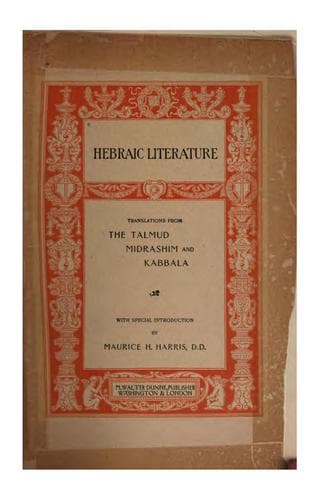
Hebraic Literature; Translations from the Talmud, Midrashim and Kabbala
Religion
Hebraic Literature; Translations from the Talmud, Midrashim and Kabbala
Hebrew literature -- Translations into English
The Rabbis have said that he who has failed to participate in the
keeping of the Tabernacle Festival in Jerusalem has failed to taste real
enjoyment in his life. The first day of the feast was kept with great
solemnity, and the middle days with joy and gladness in various methods
of public amusement.
The Temple in Jerusalem was provided with a gallery for the women, which
was called the apartment of the women, and the men sat below, as is
still the custom of the synagogue. Thither all repaired. The young
priests filled the lamps of the large chandeliers with oil, and lighted
them all, even that the place was so bright that its reflection lighted
the streets of the city. Hymns and praises were chanted by the pious
ones, and the Levites praised the Lord with harps, cornets, trumpets,
flutes, and other instruments of harmony. They stood upon fifteen broad
steps, reaching from the lower floor to the gallery, the court of the
women. And they sang fifteen psalms as they ascended, beginning with "A
song of Degrees," and the large choir joined voices with them. The
ancient Hillel was accustomed to address the assemblages on these
occasions.
"If God's presence dwells here," he was used to say, "then are ye here,
each one of you, the souls of each; but if God should be removed from
your midst through disobedience then which of you could be here?" For
the Lord has said "If thou wilt come to My house, then will I come to
thy house, but if thou refusest to visit My dwelling, I will also
neglect to enter yours;" as it is written, "In every place where I shall
permit My name to be mentioned I will come unto thee and I will bless
thee."
Then some of the people answered:--
"Happy were the days of our youth, for they have not set to blush the
days of our old age." These were men of piety.
Others answered:--
"Happy is our old age, for therein have we atoned for the sins of our
youth." These were repentants.
Then joining together, both parties said:--
"Happy is the one who is free from sin; but ye who have sinned, repent,
return to God, and ye will be forgiven."
The festival was continued during the entire night; for when the
religious exercises concluded the people gave themselves up to innocent
but thorough enjoyment.
This festival was also called the "Festival of Drawing Water."
Because, during the existence of the Temple, wine was offered during the
year for a burnt-offering, but on the Feast of Tabernacles they offered
two drink-offerings, one of wine and one of water. Of the other they
made a special festival on the second day of the Tabernacle assemblage,
calling it the Feast of Drawing the Water. It was founded upon the words
of the prophet:--
"And ye shall draw water with joy from the fountains of salvation."
HANNUKAH
Public-domain text, read in full here on John Shaqi.
Reviews
Reviews
No reviews yet
Be the first to share your thoughts on this work.
Elsewhere in the archive
Join the Discussion
Join the discussion
Sign in to leave a comment or review.
Sign InorCreate an account