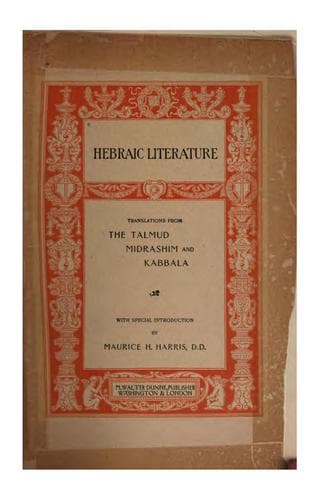
Hebraic Literature; Translations from the Talmud, Midrashim and Kabbala
Religion
Hebraic Literature; Translations from the Talmud, Midrashim and Kabbala
Hebrew literature -- Translations into English
It is said that Rabbi (the Holy) teaches that it is illegal for an
unlearned man to eat animal food, for it is said (Lev. xi. 46), "This is
the law of the beast and the fowl;" therefore he who studies the law may
eat animal food, but he who does not study the law may not. Rabbi
Eliezar said, "It is lawful to split open the nostrils of an unlearned
man, even on the Day of Atonement which happens to fall on a Sabbath."
To which his disciples responded, "Rabbi, say rather to slaughter him."
He replied, "Nay, that would require the repetition of the usual
benediction; but in tearing open his nostrils no benedictory formula is
needed." Rabbi Eliezar has also said, "It is unlawful to travel with
such a one, for it is said (Deut. xxx. 30), 'For it is thy life and the
length of thy days.' The unlearned does not ensure his own life (since
he has no desire to study the law, which would prolong life), how much
less then will he regard the life of his neighbor?" Rabbi Samuel, son of
Nachman, says on behalf of Rabbi Yochanan, that it is lawful to split
open an unlearned man like a fish. "Aye," adds Rabbi Samuel, "and that
from his back."
_P'sachim_, fol. 49, col. 2.
Rav Yehudah says it is good to eat the pulp of a pumpkin with beetroot
as a remedy, also the essence of hemp seed in Babylonian broth; but it
is not lawful to mention this in the presence of an illiterate man,
because he might derive a benefit from the knowledge not meant for him.
_Nedarim_, fol. 49, col. 1.
No contribution or heave-offering should be given to an ignorant priest.
_Sanhedrin_, fol. 90, col. 2.
No boor can be pious, nor an ignorant man a saint.
_Avoth_, chap. 2, mish. 6.
Sleep in the morning, wine at mid-day, the idle talk of inexperienced
youth, and attending the conventicles of the ignorant drive a man out of
the world.
Ibid., chap. 3, mish. 16.
Rabbi Jonathan says, "Where do we learn that no present is to be made to
an ignorant priest?" In 2 Chron. xxxi. 4, for there it is said Hezekiah
"commanded that all the people that dwelt in Jerusalem should give a
portion to the priests and to the Levites, that they might be strong in
the law of the Lord." He who firmly lays hold of the law has a claim to
a portion, otherwise he has none.
_Chullin_, fol. 130, col. 2.
The aged, if ignorant, grow weaker in intellect the older they become in
years, for it is written (Job xii. 20), "He removeth away the speech of
the trusty, and taketh away the understanding of the aged." But it is
not so with them that are old in the study of the law, for the older
they grow the more thoughtful they become, and the wiser, as it is said
(Job xii. 12), "With the ancient is wisdom, and in length of days
understanding."
_Kinnin_, chap. 3.
The salutation of the ignorant should be responded to quietly, and with
a reluctant nod of the head.
_Taanith_, fol. 14, col. 2.
No calamities ever befall the world except such as are brought on by the
ignorant.
_Bava Bathra_, fol. 8, col. 1.
Public-domain text, read in full here on John Shaqi.
Reviews
Reviews
No reviews yet
Be the first to share your thoughts on this work.
Elsewhere in the archive
Join the Discussion
Join the discussion
Sign in to leave a comment or review.
Sign InorCreate an account