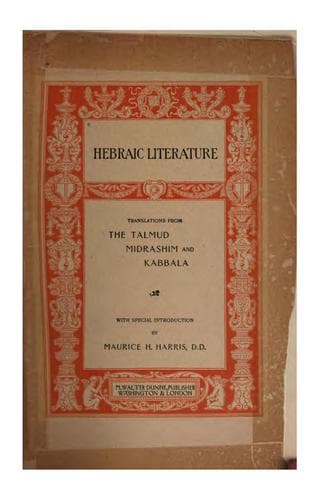
Hebraic Literature; Translations from the Talmud, Midrashim and Kabbala
Religion
Hebraic Literature; Translations from the Talmud, Midrashim and Kabbala
Hebrew literature -- Translations into English
In Ecclesiastes ii. 8, we read, "I gat me men singers and women
singers, the delights of the sons of men, as musical
instruments, and that of all sorts." These last seven words
represent only two in the original Hebrew, _Shiddah-veshiddoth_.
These two words in the original Hebrew translated by the last
seven in this verse, have been a source of great perplexity to
the critics, and their exact meaning is matter of debate to this
hour. They in the West say they mean severally carriages for
lords and carriages for ladies, while we, says the Babylonish
Talmud, interpret them to signify male demons and female demons.
Whereupon, if this last is the correct rendering, the question
arises, for what purpose Solomon required them? The answer is to
be found in 1 Kings vi. 7, where it is written, "And the house,
when it was in building, was built of stone made ready before it
was brought thither," etc. For before the operation commenced
Solomon asked the Rabbis, "How shall I accomplish this without
using tools of iron?" and they remembering of an insect which
had existed since the creation of the world, whose powers were
such as the hardest substances could not resist, replied, "There
is the Shameer, with which Moses cut the precious stones of the
Ephod." Solomon asked, "And where, pray, is the Shameer to be
found?" To which they made answer, "Let a male demon and a
female come, and do thou coerce them both; mayhap they know and
will reveal it to thee." He then conjured into his presence a
male and a female demon, and proceeded to torture them, but in
vain, for said they, "We know not its whereabouts and cannot
tell; perhaps Ashmedai, the king of the demons, knows." On being
further interrogated as to where he in turn might be found, they
made this answer: "In yonder mount is his residence; there he
has dug a pit, and, after filling it with water, covered it over
with a stone, and sealed with his own seal. Daily he ascends to
heaven and studies in the school of wisdom there, then he comes
down and studies in the school of wisdom here; upon which he
goes and examines the seal, then opens the pit, and after
quenching his thirst, covers it up again, re-seals it, and takes
his departure."
Public-domain text, read in full here on John Shaqi.
Reviews
Reviews
No reviews yet
Be the first to share your thoughts on this work.
Elsewhere in the archive
Join the Discussion
Join the discussion
Sign in to leave a comment or review.
Sign InorCreate an account