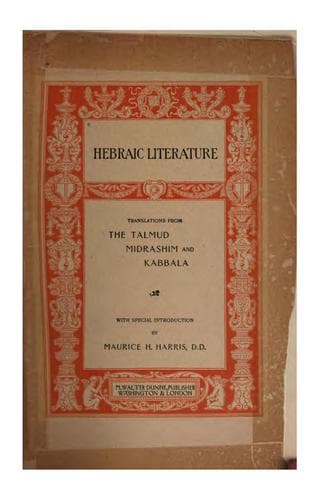
Hebraic Literature; Translations from the Talmud, Midrashim and Kabbala
Religion
Hebraic Literature; Translations from the Talmud, Midrashim and Kabbala
Hebrew literature -- Translations into English
Benaiah asked Ashmedai why, when he saw the blind man straying,
he so promptly interfered to guide him? "Because," he replied,
"it was proclaimed in heaven that that man was perfectly
righteous, and that whosoever did him a good turn would earn a
title to a place in the world of the future." "And when thou
sawest the man overcome with wine wandering out of his way, why
didst thou put him right again?" Ashmedai said, "Because it was
made known in heaven that that man was thoroughly bad, and I
have done him a good service that he might not lose all, but
receive some good in the world that now is." "Well, and why
didst thou weep when thou sawest the merry wedding-party pass?"
"Because," said he, "the bridegroom was fated to die within
thirty days and the bride must needs wait thirteen years for her
husband's brother, who is now but an infant" (see Deut. xxv.
5-10). "Why didst thou laugh so when the man ordered a pair of
shoes that would last him seven years?" Ashmedai replied,
"Because the man himself was not sure of living seven days."
"And why," asked Benaiah, "didst thou jeer when thou sawest the
conjuror at his tricks?" "Because," said Ashmedai, "the man was
at that very time sitting on a princely treasure, and he did
not, with all his pretension, know that it was under him."
Having once acquired a power over Ashmedai, Solomon detained him
till the building of the Temple was completed. One day after
this, when they were alone, it is related that Solomon,
addressing him, asked him, "What, pray, is your superiority over
us, if it be true, as it is written (Num. xxiii. 22), 'He has
the strength of a unicorn,' and the word 'strength,' as
tradition alleges, means 'ministering angels,' and the word
'unicorn' means 'devils'?" Ashmedai replied, "Just take this
chain from my neck, and give me thy signet-ring, and I'll soon
show thee my superiority." No sooner did Solomon comply with
this request, than Ashmedai, snatching him up, swallowed him;
then stretching forth his wings--one touching the heaven and the
other the earth--he vomited him out again to a distance of four
hundred miles. It is with reference to this time that Solomon
says (Eccl. i. 3; ii. 10), "What profit hath a man of all his
labor which he taketh under the sun? This is my portion of all
my labor." What does the word this mean? Upon this point Rav and
Samuel are at variance, for the one says it means his staff, the
other holds that it means his garment or water-jug; and that
with one or other Solomon went about from door to door begging;
and wherever he came he said (Eccl. i. 12), "I, the preacher,
was king over Israel in Jerusalem." When in his wanderings he
came to the house of the Sanhedrin, the Rabbis reasoned and
said, if he were mad he would not keep repeating the same things
Public-domain text, read in full here on John Shaqi.
Reviews
Reviews
No reviews yet
Be the first to share your thoughts on this work.
Elsewhere in the archive
Join the Discussion
Join the discussion
Sign in to leave a comment or review.
Sign InorCreate an account