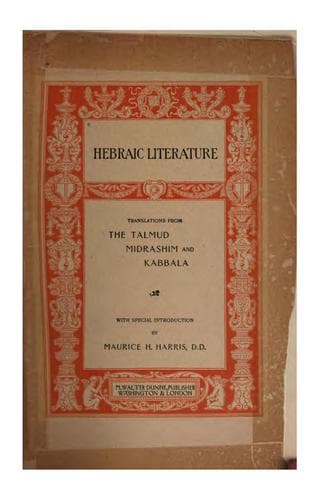
Hebraic Literature; Translations from the Talmud, Midrashim and Kabbala
Religion
Hebraic Literature; Translations from the Talmud, Midrashim and Kabbala
Hebrew literature -- Translations into English
"These six of barley gave he me." What does this mean? It cannot surely
be understood of six barleycorns, for it could not be the custom of Boaz
to give a present of six grains of barley. It must, therefore, have been
six measures. But was it usual for a woman to carry such a load as six
measures would come to? What he intended by the number six was to give
her a hint that in process of time six sons would proceed from her, each
of which would be blessed with six blessings; and these were David, the
Messiah, Daniel, Hananiah, Mishael, and Azariah. David, as it is written
(1 Sam. xvi. 8), (1.) "Cunning in playing," (2.) "and a mighty and
valiant man," (3.) "a man of war," (4.) "prudent in matters," (5.) "a
comely person," (6.) and "the Lord is with him." The Messiah, for it is
written (Isa. xi. 2), "And the Spirit of the Lord shall rest upon him,"
viz, (1.) "The spirit of wisdom and (2.) understanding, (3.) the spirit
of counsel and (4.) might, (5.) the spirit of knowledge, and (6.) the
fear of the Lord." Daniel, Hananiah, Mishael, and Azariah, for regarding
them it is written (Dan. i. 4), (1.) "Young men in whom was no blemish,"
(2.) "handsome in looks," (3.) "intelligent in wisdom," (4.) "acquainted
with knowledge," (5.) "and understanding science, and such as (6.) had
ability to stand in the palace of the king," etc. But what is the
meaning of unblemished? Rav Chama ben Chanania says it means that not
even the scar of a lancet was upon them.
_Sanhedrin_, fol. 93, cols, 1, 2.
The words "not even the scar of a lancet was upon them," bespeak
the prevalence of blood-letting in the East, and the absence of
the scar of the lancet on the persons of Daniel and his
companions is a testimony to their health of body and moral
temperance and purity.
In Taanith (fol. 21, col. 2) mention is made of a certain
phlebotomist--a noteworthy exception to the well-known rule (see
Kiddushin, fol. 82, col. 2) that phlebotomists are to be
regarded as morally depraved, and in the same class with
goldsmiths, perfumers, hairdressers, etc.,--Abba Umna by name,
who had a special mantle with slits in the sleeves for females,
so that he could surgically operate upon them without seeing
their naked arms, while he himself was covered over head and
shoulders in a peculiar cloak, so that his own face could not by
any chance be seen by them.
From Shabbath, fol. 156, col. 1, we learn that a person born
under the influence of Maadim, i.e., Mars, will in one way or
another be a shedder of blood, such as a phlebotomist, a butcher,
a highwayman, etc., etc.
Public-domain text, read in full here on John Shaqi.
Reviews
Reviews
No reviews yet
Be the first to share your thoughts on this work.
Elsewhere in the archive
Join the Discussion
Join the discussion
Sign in to leave a comment or review.
Sign InorCreate an account