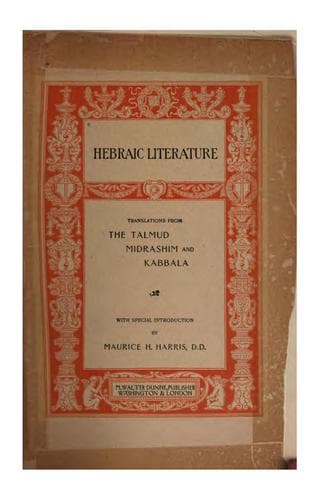
Hebraic Literature; Translations from the Talmud, Midrashim and Kabbala
Religion
Hebraic Literature; Translations from the Talmud, Midrashim and Kabbala
Hebrew literature -- Translations into English
Six blasts of the horn were blown on Sabbath-eve. The first was to set
free the laborers in the fields from their work; those that worked near
the city waited for those that worked at a distance and all entered the
place together. The second blast was to warn the citizens to suspend
their employments and shut up their shops. At the third blast the women
were to have ready the various dishes they had prepared for the Sabbath
and to light the lamps in honor of the day. Then three more blasts were
blown in succession, and the Sabbath commenced.
_Shabbath_, fol. 35, col. 2.
He who passes seven nights in succession without dreaming deserves to be
called wicked.
_Berachoth_, fol. 14, col. 1.
Gehinnom has seven names:--Sheol (Jonah ii. 2), Avadon (Ps. lxxxviii.
11), Shachath (Ps. xvi. 2), Horrible pit (Ps. xl. 2), Miry clay (Ps. xl.
2), the Shadow of death (Ps. cvii. 14), the Subterranean land.
_Eiruvin_, fol. 19, col. 1.
A dog in a strange place does not bark for seven years.
Ibid., fol. 61, col. 1.
Seven things were formed before the creation of the world:--The Law,
Repentance, Paradise, Gehenna, the Throne of Glory, the Temple, and the
name of the Messiah.
_P'sachim_, fol. 54, col. 1.
The Midrash Yalkut (p. 7) enumerates the same list almost word
for word, and the Targum of Ben Uzziel develops the tradition
still further, while the Targum Yerushalmi fixes the date of the
origin of the seven prehistoric wonders at "two thousand years
before the creation of the world."
Seven things are hid from the knowledge of a man:--The day of death, the
day of resurrection, the depth of judgment (i.e., the future reward or
punishment), what is in the heart of his fellow-man, what his reward
will be, when the kingdom of David will be restored, and when the
kingdom of Persia will fall.
_P'sachim_, fol. 54, col. 2.
Seven are excommunicated before heaven:--A Jew who has no wife, and even
one who is married but has no male children; and he that has sons but
does not train them up to study the law; he who does not wear
phylacteries on his forehead and upon his arm and fringes upon his
garment, and has no mezuzah on his doorpost; and he who goes barefooted.
Ibid., fol. 113, col. 2.
There are seven skies:--Villon, Raakia, Shechakim, Zevul, Maaon,
Maachon, and Aravoth.
_Chaggigah_, fol. 12, col. 2.
Seven days before the Day of Atonement they removed the high priest from
his own residence to the chamber of the President, and appointed another
priest as his deputy in case he should meet with such an accident as
would incapacitate him from going through the service of the day. Rabbi
Yehudah says they also had to betroth him to another woman lest his own
wife should die meanwhile, for it is said, "And he shall make an
atonement for himself and for his house,"--his house, that is, his wife.
In reference to this precautionary rule it was observed, there might
then be no end to the matter (Rashi), should this woman die also.
Public-domain text, read in full here on John Shaqi.
Reviews
Reviews
No reviews yet
Be the first to share your thoughts on this work.
Elsewhere in the archive
Join the Discussion
Join the discussion
Sign in to leave a comment or review.
Sign InorCreate an account