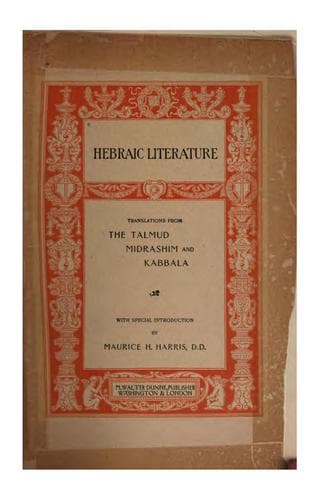
Hebraic Literature; Translations from the Talmud, Midrashim and Kabbala
Religion
Hebraic Literature; Translations from the Talmud, Midrashim and Kabbala
Hebrew literature -- Translations into English
_Chullin_, fol. 132, col. 2.
If a case of mistaken identity should occur between the child of a
priestess and the child of her female slave, so that the one cannot be
distinguished from the other, they both are to eat of the heave-offering
and to receive one share from the threshing-floor. When grown up, each
is to set the other free.
_Gittin_, fol. 42, col. 2.
From the old clothes of the priests the wicks were made for the lamps in
the Temple.
_Shabbath_, fol. 21, col. 1.
Scripture authority is given in proof that the very garments possessed
the faculty of making atonement for sin every whit as effectually as
animal sacrifices. We are taught that the priest's shirt atones for
murder, his drawers atone for whoredom, his mitre for pride, his girdle
for evil thoughts, his breastplate for injustice, his ephod for
idolatry; his overcoat atones for slander, and the golden plate on his
forehead atones for impudence.
_Zevachim_, fol. 88, col. 2.
All this and a great deal more on the subject may be found in
the Selichoth for Yom Kippur.
For seven years was the land of Israel strewn with brimstone and salt.
_Yoma_, fol. 54, col. 1.
"Then shall we raise against him seven shepherds" (Micah. v. 5). Who are
these seven shepherds? David in the middle: Adam, Seth, and Methuselah
on his right hand; Abraham, Jacob, and Moses on his left.
_Succah_, fol. 52, col. 2.
Who were the seven prophetesses? The answer is, Sarah, Miriam, Deborah,
Hannah, Abigail, Huldah, and Esther.
_Meggillah_, fol. 14, col. 2.
It is lawful to look into the face of a bride for seven days after her
marriage, in order to enhance the affection with which she is regarded
by her husband, and there is no Halachah (or law) like this.
_Kethuboth_, fol. 17, col. 1.
The Rabbis are especially careful to caution their daughters to
guard against such habits as might lower them in the regard of
their husbands, lest they should lose aught of that purifying
and elevating power which they exercised as maidens. It is thus,
for instance, Rav Chisda counsels his daughters: "Be ye modest
before your husbands and do not even eat before them. Eat not
vegetables or dates in the evening, and touch not strong drink."
(_Shabbath_, fol. 140, col. 2.)
Once upon a time a demon in the shape of a seven-headed dragon came
forth against Rav Acha and threatened to harm him, but the Rabbi threw
himself on his knees, and every time he fell down to pray he knocked off
one of these heads, and thus eventually killed the dragon.
_Kiddushin_, fol. 29, col. 2.
On the seventh of the month Adar, Moses died, and on that day the manna
ceased to come down from heaven.
Ibid., fol. 38, col. 1.
Public-domain text, read in full here on John Shaqi.
Reviews
Reviews
No reviews yet
Be the first to share your thoughts on this work.
Elsewhere in the archive
Join the Discussion
Join the discussion
Sign in to leave a comment or review.
Sign InorCreate an account