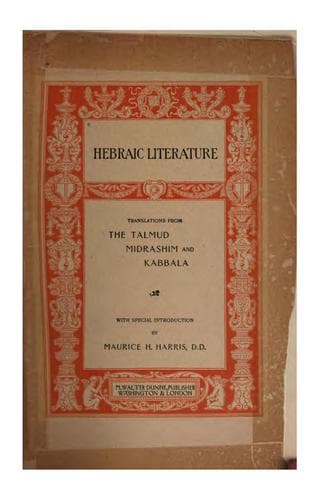
Hebraic Literature; Translations from the Talmud, Midrashim and Kabbala
Religion
Hebraic Literature; Translations from the Talmud, Midrashim and Kabbala
Hebrew literature -- Translations into English
The number of high priests who officiated in succession during the 410
years of the continuance of the first Temple was only eighteen, but the
number who held office during the 420 years of the second Temple
amounted to more than three hundred, most of them having died within a
year after their entrance upon the office. The reason assigned by the
Talmud for the long lives of the former and the short lives of the
latter is the text given in Prov. x. 27, "The fear of the Lord
prolongeth days, but the years of the wicked shall be shortened."
_Yoma_, fol. 9, col. 1.
Before a priest could be admitted into active service in the Temple he
had to undergo bodily inspection at the hands of the syndicate of the
Sanhedrin. If they found the least defect in his body, even a mole with
hair upon it, he was ordered to dress in black and be dismissed; but if
he was perfectly free from blemish, he was arrayed in white, and at once
introduced to his brother priests and official duties.
Ibid., fol. 19, col. 1.
The daughters of a male proselyte who has married the daughter of a
female proselyte are eligible to marry priests.
_Yevamoth_, fol. 57, col. 1.
If thou seest an impudent priest, think not evil of him; for it is said
(Hosea iv. 4), "Thy people are as they that strive with the priest" (see
chap. ii. p. 25, Note c.).
_Kiddushin_, fol. 70, col. 2.
So long as there is a diadem on the head of the priest, there is a crown
on the head of every man. Remove the diadem from the head of the high
priest and you take away the crown from the head of all the people.
(This is a Talmudic comment on Ezek. xxi. 31; A. Ver., 26.)
_Gittin_, fol. 7, col. 1.
A king shaved his head every day, a high priest did the same once a
week, and an ordinary priest once a month.
_Sanhedrin_, fol. 22, col. 2.
When a priest performs the service of the Temple in a state of
defilement, his brother priests are not required to lead him before the
tribunal, but the juniors of the priestly order are to drag him out into
the hall and brain him with clubs.
_Sanhedrin_, fol. 81, col. 2.
When kings were anointed, the holy oil was laid on the forehead in the
form of a coronet, and when, says Rabbi Mansi bar Gadda, priests were
anointed, the operation was performed in the shape of the Greek letter
k.
_Horayoth_, fol. 12, col. 1.
A learned man who is of illegitimate birth is preferable to an ignorant
priest.
Ibid., fol. 13, col. 1.
A priest who makes no confession during service has no part in the
priesthood. (He forfeits his emoluments.)
_Menachoth_, fol. 18, col. 2.
The bald-headed, the dwarfed, and the blear-eyed are ineligible for the
priesthood.
_Bechoroth_, fol. 43, col. 2.
Rav Chisda says, "The portions that fall to the priests are not to be
eaten except roasted and that with mustard," because Scripture says
(Num. xviii. 8), "by reason of the anointing," i.e., by way of
distinction, for only kings (who, of course, are anointed) eat roast
meat with mustard.
Public-domain text, read in full here on John Shaqi.
Reviews
Reviews
No reviews yet
Be the first to share your thoughts on this work.
Elsewhere in the archive
Join the Discussion
Join the discussion
Sign in to leave a comment or review.
Sign InorCreate an account