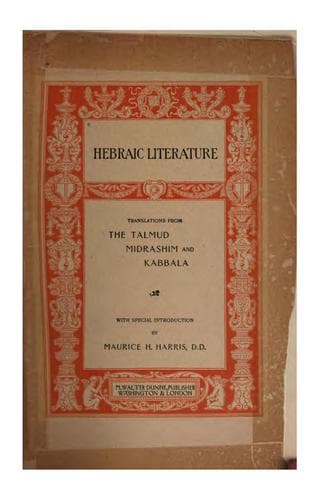
Hebraic Literature; Translations from the Talmud, Midrashim and Kabbala
Religion
Hebraic Literature; Translations from the Talmud, Midrashim and Kabbala
Hebrew literature -- Translations into English
Seven precepts did Rabbi Akiva give to his son Rabbi Yehoshua:--(1.) My
son, teach not in the highest place of the city; (2.) Dwell not in a
city where the leading men are disciples of the wise; (3.) Enter not
suddenly into thine own house, and of course not into thy neighbor's;
(4.) Do not go about without shoes; (5.) Rise early and eat in summer
time because of the heat, and in winter time because of the cold; (6.)
Make thy Sabbath as a week-day rather than depend for support on other
people; (7.) Strive to keep on close friendly terms with the man whom
fortune favors (lit. on whom the present hour smiles). Rav Pappa adds,
"This does not refer to buying or selling, but to partnership."
Ibid.
How is it proved that mourning should be kept up for seven days? It is
written (Amos viii. 10), "I will turn your feasts into mourning," and
these in many cases lasted seven days.
_Moed Katon_, fol 20, col. 1.
Rav Chisda said there are seven kinds of gold:--Gold, good gold, the
gold of Ophir, purified gold, beaten gold, shut-up gold, and gold of
Parvain.
_Yoma_ fol. 44, col. 2.
The shut-up gold (1 Kings vi. 12) was of the purest and rarest
quality, so that when it appeared in the market for sale, all
shops in the locality were "shut up," for there could be no sale
of any other gold before that. All gold-dealers "shut up" their
shops in order to be present on so rare an occasion; and hence
the name of this kind of gold--"shut-up gold."
Each day of the Feast of Tabernacles they walked round the altar once,
and said, "O Lord, save us, we beseech Thee! O Lord, prosper us, we
beseech Thee!" But on the last day they encompassed it seven times. On
their departure they said, "Beauty belongeth to thee, O altar! Beauty
belongeth to thee, O altar!"
_Succah_, fol. 45, col. 1.
It deserves to be noted here for the information of some of our
readers that the words translated above, Save now, or Save, we
beseech thee, are the original of our word Hosanna. The 25th and
26th verses of Psalm cxviii, which begin with this expression,
were repeated at the Feast of Tabernacles; and hence the bundles
of palm and willow branches (carried on this occasion), the
prayers, and the festival itself, were so named, i.e. Hosanna.
Public-domain text, read in full here on John Shaqi.
Reviews
Reviews
No reviews yet
Be the first to share your thoughts on this work.
Elsewhere in the archive
Join the Discussion
Join the discussion
Sign in to leave a comment or review.
Sign InorCreate an account