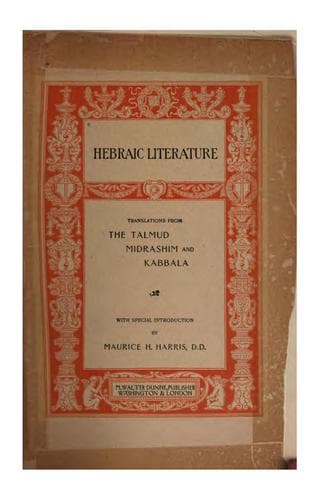
Hebraic Literature; Translations from the Talmud, Midrashim and Kabbala
Religion
Hebraic Literature; Translations from the Talmud, Midrashim and Kabbala
Hebrew literature -- Translations into English
The Tempter is known by seven distinctive epithets:--(1) The Holy
One--blessed be He!--calls him evil; as it is said, "For the imagination
of man's heart is evil." (2.) Moses calls him uncircumcised; as it is
said (Deut. x. 16), "Circumcise therefore the uncircumcised foreskin of
your heart." (3.) David calls him unclean; as it is said (Ps. li. 10),
"Create in me a clean heart, O God!" Consequently there must be an
unclean one. (4.) Solomon calls him enemy; as it is said (Prov. xxv. 21,
22), "If thine enemy hunger, give him bread to eat; if he be thirsty,
give him water to drink; for thus thou shalt heap coals of fire upon his
head, and the Lord shall reward thee" (i.e., oppose him with the law.
The word rendered bread, is metaphorically taken for the law, Prov. ix.
5, so that give him water to drink means also the law, Isa. lv.
1--Rashi. And the Lord reward thee, read not reward, but cause him to
make peace with thee, not to war against thee.) (5.) Isaiah calls him
stumbling-block; as it is said (Isa. lvii. 14), "Cast ye up, cast ye up,
prepare the way, take up the stumbling-block out of the way of my
people." (6.) Ezekiel calls him stone; as it is said (Ezek. xxxvi. 26),
"I will take away the heart of stone out of your flesh and I will give
you a heart of flesh." (7.) Joel calls him the hidden one; as it is said
(Joel ii. 20), "I will remove far from you the hidden one," i.e., the
tempter who remains hidden in the heart of man; "and I will drive him
into a land barren and desolate," i.e., where the children of men do not
usually dwell; "with his face toward the former sea," i.e., with his
eyes set upon the first Temple, which he destroyed, slaying the
disciples of the wise that were in it; "and his hinder part toward the
latter sea," i.e., with his eyes set on the second Temple, which he
destroyed, also slaying the disciples of the wise that were in it.
_Succah_, fol. 52, col. 1.
Public-domain text, read in full here on John Shaqi.
Reviews
Reviews
No reviews yet
Be the first to share your thoughts on this work.
Elsewhere in the archive
Join the Discussion
Join the discussion
Sign in to leave a comment or review.
Sign InorCreate an account