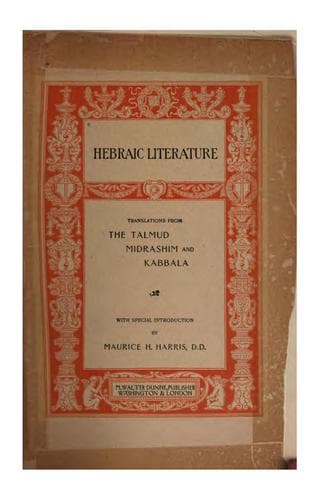
Hebraic Literature; Translations from the Talmud, Midrashim and Kabbala
Religion
Hebraic Literature; Translations from the Talmud, Midrashim and Kabbala
Hebrew literature -- Translations into English
The following extract states the occasion when the wearing of
phylacteries was prescribed as an equivalent that would be accepted
instead of the observance of the law:--"Rabbi Eliezer said the
Israelites complained before God one day, 'We are anxious to be occupied
day and night in the law, but we have not the necessary leisure.' Then
the Holy One--blessed be He!--said to them, 'Perform the commandment of
the phylacteries, and I will count it as if you were occupied day and
night in the law.'" (_Yalhut Shimeoni_). Phylacteries, fringes, and
Mezuzah, these three preserve one from sin; as it is said (Eccl. iv. 2),
"A threefold cord is not quickly broken;" as also in Ps. xxxiv. 7, "The
angel of the Lord encampeth about them that fear Him, and delivereth
them."
Ibid., fol. 43, col. 2.
The harp in the time of the Messiah will have eight strings; as it is
written (Ps. xii. 1), "The chief musician upon eight," etc.
_Eirchin_, fol. 13, col. 2.
On the ninth day of the month Ab (about August) both the first Temple
and the second were destroyed.
_Rosh Hashanah_, fol. 18, col. 2.
In 2 Kings xxv. 8, the seventh of Ab is the date given for the
first of these events, whereas Jeremiah (lii. 12) mentions the
tenth as the fatal day. Josephus (Wars of the Jews, Book vi.
chap. 4, sec. 15) coincides with the latter.
On the ninth of Ab one must abstain from eating and drinking, and
anointing one's self, and wearing shoes, and matrimonial intercourse. He
may not read the Bible, the Talmud, the Midrash, the Halachoth, or the
Haggadoth, excepting such portions as he is not in the habit of reading,
such he may then read. The lamentations, Job, and the hard words of
Jeremiah should engage his study. Children should not go to school on
this day, because it is said (Ps. xix. 8), "The statutes of the Lord are
right, rejoicing the heart."
_Taanith_, fol. 30, col. 1.
Nowadays, on the date referred to, Jews do not wear their
tallith and phylacteries at morning prayer; by this act laying
aside the outward signs of their covenant with God; but,
contrary to custom, they put them on in the evening, when the
fast is nearly over.
He who does any work on the ninth of Ab will never see even a sign of
blessing. The sages say, whoso does any work on that day and does not
lament over Jerusalem will never see her joy; for it is said (Isa. lxvi.
10), "Rejoice ye with Jerusalem, and be glad with her; rejoice for joy,
all ye that mourn for her."
_Taanith_, fol. 30, col. 2.
If there be nine shops all selling the meat of animals which have been
legally butchered, and one selling the meat of animals which have not,
and if a person who has bought meat does not know at which of these
shops he bought it, he is not entitled to the benefit of the doubt; the
meat he has purchased is prohibited.
_Kethuboth_, fol. 15, col. 1.
A woman prefers one measure of frivolity to nine measures of Pharisaic
sanctimoniousness.
_Soteh_, fol. 20, col. 1.
Public-domain text, read in full here on John Shaqi.
Reviews
Reviews
No reviews yet
Be the first to share your thoughts on this work.
Elsewhere in the archive
Join the Discussion
Join the discussion
Sign in to leave a comment or review.
Sign InorCreate an account