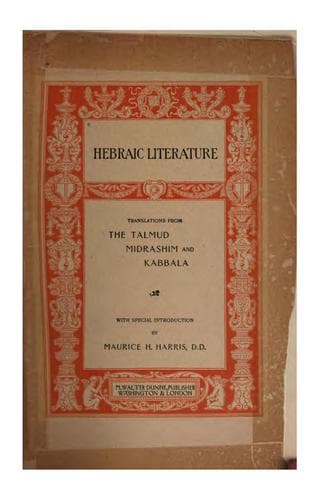
Hebraic Literature; Translations from the Talmud, Midrashim and Kabbala
Religion
Hebraic Literature; Translations from the Talmud, Midrashim and Kabbala
Hebrew literature -- Translations into English
The Talmud has much to say, and does say a great deal, about women. And
although what it says tends rather to discountenance than to promote
their development, it is not insensible to what they might become under
refinement of culture, and occasionally enforces the duty of attending
to their higher education. In proof of both positions we appeal to the
following quotations:--
In the Mishna, from which the above quotation is taken, we are told that
Ben Azai (the son of impudence) says, a man is bound to instruct his
daughter in the law, although Rabbi Eliezer, who always assumes an
oracular air, and boasts that the Halachah is always according to his
decision (_Bava Metzia_, fol. 59, col. 2), insists, on the other hand,
that he who instructs his daughter in the law must be considered as
training her into habits of frivolity; and the saying above ascribes to
the sex such a power of frivolity as connects itself evidently with the
foregone conclusion that they are by nature incapable of being developed
into any solidity of worth or character. The Gemara, Tosephoth, and
Rashi as well all support Rabbi Eliezer in laying a veto on female
education, for fear lest, with the acquisition of knowledge, women might
become cunning, and do things on the sly which ought not to be done by
them. Literally the saying is:--For from it (i.e., the acquisition of
knowledge) she comes to understand cunning, and does things on the
quiet.
_Soteh_, fol. 21, col. 2, Rashi.
Another good reason for neglecting female education those who take the
Talmud as an authority find in these words: women are light-minded,
i.e., of shallow natural endowment, on which any serious discipline
would be thrown away.
_Kiddushin_, fol. 80, col. 2.
Another argument to the same effect is, that there is no distinct
command in the law of Moses inculcating the duty; for in Deut. xi. 19 it
is merely said, "And ye shall teach them to your children," a command
which, as it passes refracted through the Rabbinic medium, becomes your
sons, but not your daughters.
Ibid., fol. 29, col. 2.
As the immediately preceding command, so interpreted, cannot be carried
out by any one not favored with male children, the well-known Talmudic
dictum acquires force and point, "Blessed is the man whose children are
sons, but luckless is he whose children are daughters."
_Bava Bathra_, fol. 16, col. 2.
A man prefers one measure obtained by his own earning to nine measures
collected by the exertion of his neighbor.
_Bava Metzia_, fol. 38, col. 1.
Nine have entered alive into paradise, and these are they:--Enoch, the
son of Jared; Elijah; the Messiah; Eliezer, the servant of Abraham;
Hiram, king of Tyre; Ebed Melech, the Ethiopian; Jabez, the son of Rabbi
Yehuda the prince; Bathia, the daughter of Pharaoh; and Sarah, the
daughter of Asher. Some say also Rabbi Yoshua, the son of Levi.
_Derech Eretz Zuta_, chap. 1.
Public-domain text, read in full here on John Shaqi.
Reviews
Reviews
No reviews yet
Be the first to share your thoughts on this work.
Elsewhere in the archive
Join the Discussion
Join the discussion
Sign in to leave a comment or review.
Sign InorCreate an account