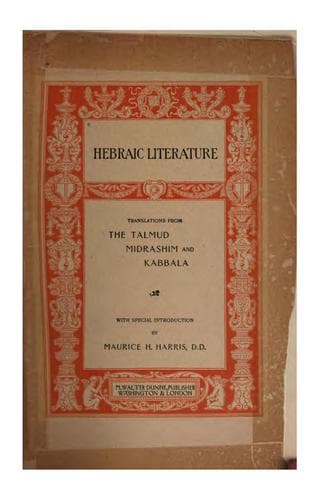
Hebraic Literature; Translations from the Talmud, Midrashim and Kabbala
Religion
Hebraic Literature; Translations from the Talmud, Midrashim and Kabbala
Hebrew literature -- Translations into English
God is represented as roaring like a lion, etc., etc.
_Berachoth_, fol. 3, col. 1. See chap. iii.
God is said to wear phylacteries.
_Berachoth_, fol. 6, col. 1.
This is referred to in the morning service for Yom Kippur, where it is
said He showed "the knot of the phylacteries to the meek one" (i.e.,
Moses).
He is said to pray; for it is written (Isa. lvi. 7), "Them will I bring
to my holy mountain, and make them joyful in the house of my prayer." It
is thus He prays: "May it please me that my mercy may overcome my anger,
that all my attributes may be invested with compassion, and that I may
deal with my children in the attribute of kindness, and that out of
regard to them I may pass by judgment."
Ibid., fol. 7, col. 1.
He is a respecter of persons; as it is written (Num. vi. 26), "The Lord
lift up His countenance upon thee."
Ibid., fol. 20, col. 2.
When accused by Elijah of having turned Israel's heart back again (1
Kings xviii. 37), He confesseth the evil He had done (Micah iv. 6).
Ibid., fol. 31, col. 2.
God, when charged by Moses as being the cause of Israel's idolatry,
confesseth the justice of that accusation by saying (Num. xiv. 20), "I
have pardoned according to thy word."
Ibid., fol. 32, col. 1.
He drops two tears into the ocean, and this causes the earth to quake.
Ibid., fol. 59, col. 1.
He is represented as a hairdresser; for it is said He plaited Eve's hair
(and some have actually enumerated the braids as 700).
_Eiruvin_, fol. 18, col. 1.
In a Hagada (see Sanhedrin, fol. 95, col. 2), God is conceived as acting
the barber to Sennacherib, a sort of parody on Isaiah vii. 20.
He is said to have created the evil as well as the good passions in man.
_Berachoth_, fol. 61, col. 1.
God weeps every day.
_Chaggigah_, fol. 3, col. 2.
He dresses Himself in a veil and shows Moses the Jewish Liturgy, saying
unto him, "When the Israelites sin against me, let them copy this
example, and I will pardon their sins."
_Rosh Hashanah_, fol. 17, col. 2.
God is said to have regretted creating certain things.
_Succah_, fol. 52, col, 2.
God is represented as irrigating the land of Israel, but leaving the
rest of the earth to be watered by an angel.
_Taanith_, fol. 10, col. 1.
It is said that He will make a dance for the righteous, and as He places
Himself in the centre, they will point at Him with their fingers, and
say (Isa. xxv. 9), "Behold, this is our God; we have waited for him;...
we will be glad and rejoice in His salvation."
Ibid., fol. 31, col. 1.
God is said to have prevaricated in making peace between Abraham and
Sarah, which is not so surprising; for while one Rabbi teaches that
prevarication is under certain circumstances allowable, another asserts
it absolutely as a duty; for it is written (1 Sam. xvi. 2), "And Samuel
said, How can I go? if Saul hear it, he will kill me. And the Lord said,
Take a heifer with thee, and say, I am come to sacrifice unto the Lord."
_Yevamoth_, fol. 65, col. 2.
Public-domain text, read in full here on John Shaqi.
Reviews
Reviews
No reviews yet
Be the first to share your thoughts on this work.
Elsewhere in the archive
Join the Discussion
Join the discussion
Sign in to leave a comment or review.
Sign InorCreate an account