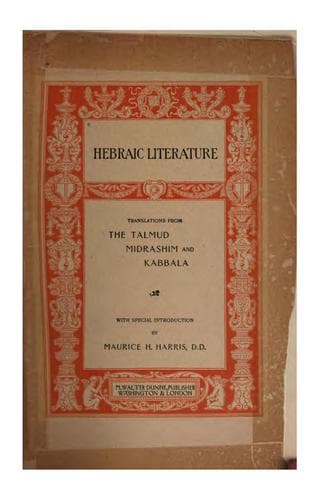
Hebraic Literature; Translations from the Talmud, Midrashim and Kabbala
Religion
Hebraic Literature; Translations from the Talmud, Midrashim and Kabbala
Hebrew literature -- Translations into English
As the last-mentioned personage, Rabbi Yoshua, entered paradise
"not by the door," but some "other way," it may be interesting
to not a few to know how he succeeded, and here accordingly we
append the story of the feat. As Rabbi Yoshua's earthly career
drew to a close, the angel of death was instructed to wait upon
him, and at the same time show all respect for his wishes. The
Rabbi, remarking the courteous demeanor of his visitant,
requested him, before he despatched him, to favor him with a
glimpse of the place he was to occupy in paradise above, and
meantime commit to him his sword, as a gage that he would grant
his petition and not take advantage of him on the journey. This
request being granted and the sword delivered up, the Rabbi and
his attendant took the road, pacing along till they halted
together just outside the gates of the celestial city. Here the
angel assisted the Rabbi to climb the wall, and proceeded to
point out the place he would occupy some day in the future, when
deftly throwing himself over, he left the angel standing outside
and holding him fast by the skirt of his garment. When pressed
to return, he swore he would not go back, protesting that, as he
had never sought to be relieved of the obligation of his oath on
earth, he would not be cajoled or coerced into an act of perjury
within the precincts of heaven. He declined at first to give up
the sword of the angel, and would have stood to his point but
for the echo of a voice which peremptorily ordered its immediate
restoration. (See _Kethuboth_ fol. 77, col. 2.)
Where is it taught that when ten join together in prayer the Shechinah
is with them? In Ps. lxxxii. 4, where it is said, "God standeth in the
congregation of the mighty."
_Berachoth_, fol. 6, col. 1.
According to Rabbinic law, it takes at least ten men to
constitute a legally convened congregation. Nearly a thousand
pounds were expended every year by the synagogues of the
metropolis to hire (minyan) men to make up the congregational
number, and thus ensure the due observance of this regulation.
When the Holy One--blessed be He!--enters the synagogue, and does not
find ten men present, His anger is immediately stirred; as it is said
(Isa. i. 2), "Wherefore, when I came, was there no man? When I called,
there was none to answer?"
Ibid., fol. 6, col. 2.
The passion of anger here ascribed to God is by not a few
regarded as an attribute wholly alien to the proper nature of
the Deity. Such, however, is evidently not the judgment of the
Talmudists. Nor is this surprising when we see elsewhere how
boldly they conceive and how freely they speak of the Divine
Majesty. The Rabbis are not in general a shamefaced generation,
and are all too prone to deal familiarly with the most sacred
realities. The excerpts which follow amply justify this
judgment.
Public-domain text, read in full here on John Shaqi.
Reviews
Reviews
No reviews yet
Be the first to share your thoughts on this work.
Elsewhere in the archive
Join the Discussion
Join the discussion
Sign in to leave a comment or review.
Sign InorCreate an account