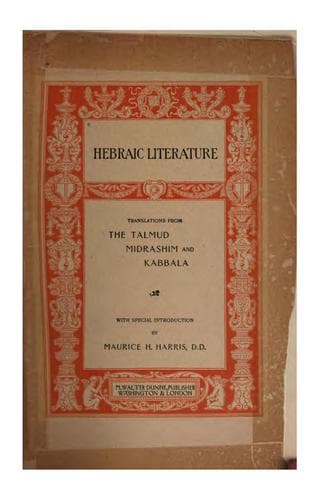
Hebraic Literature; Translations from the Talmud, Midrashim and Kabbala
Religion
Hebraic Literature; Translations from the Talmud, Midrashim and Kabbala
Hebrew literature -- Translations into English
Tradition teaches that Rabbi Yossi said:--The Shechinah has never
descended below, nor did Moses and Elijah ever ascend on high; for it is
said (Ps. cxv. 16), "The heavens, even the heavens, are the Lords; but
the earth hath he given to the children of men." True, it is written, he
admitted (Exod. xix. 20), "And the Lord came down upon Mount Sinai;" but
that, he remarked, was ten handbreadths above the summit. And true, too,
is it written (Zech. xiv. 4), "And His feet shall stand in that day upon
the Mount of Olives;" but that, too, he added, is ten handbreadths above
it. And so, in like manner, Moses and Elijah halted ten handbreadths
from heaven.
_Succah_, fol. 5, col. 1.
What entitles a place to rank as a large town? When there are in it ten
unemployed men. Should there be fewer than that number, it is to be
looked upon as a village.
_Meggillah_, fol. 3, col. 2.
In places where there are not ten Batlanim, men of leisure, that
is, men always free to be present at every synagogue service, a
minyan (number) has to be hired for the purpose. The notion that
ten constitutes a congregation is based on the authority of Num.
xiv, 27, "How long shall I bear with this congregation?" As the
term "congregation" here refers to the ten spies who brought the
evil report, it is concluded forsooth that ten men, and never
less, is the orthodox minimum for a congregation.
Ten lights, said he, could not extinguish one; how shall one extinguish
ten?
Ibid., fol. 16, col. 2.
These words are said to have been spoken by Joseph to his
brethren, who, after the death of their father Jacob, feared
lest Joseph should revenge himself upon them (Gen. l. 21). The
Midrash and the Targums as usual furnish much additional
information.
Rav Assi said:--Nowadays, if a Gentile should betroth a Jewess, there is
reason for regarding the betrothal as not therefore invalid, for he may
be a descendant of the ten tribes, and so one of the seed of Israel.
_Yevamoth_, fol. 16, col. 2.
Rabbi Yochanan said:--If, after the death of her husband, a woman should
remain unmarried for ten years and then marry again, she will have no
children. Rav Nachman added:--Provided she have not thought of marrying
all the while; but if she had thought of marrying again, in that case
she will have children. Rava once said to Rav Chisda's daughter (who
bore children to Rava, though she did not marry him until ten years
after her first husband's death), "The Rabbis have their doubts about
you." She replied, "I had always set my heart upon thee." A woman once
said to Rav Yoseph, "I waited ten years before I married again, and then
I had children." "Daughter," said he, "do not bring the words of the
wise into discredit. It is thou, not they, that are mistaken." Then the
woman confessed that she had been a transgressor.
Ibid., fol. 34, col. 2.
Public-domain text, read in full here on John Shaqi.
Reviews
Reviews
No reviews yet
Be the first to share your thoughts on this work.
Elsewhere in the archive
Join the Discussion
Join the discussion
Sign in to leave a comment or review.
Sign InorCreate an account