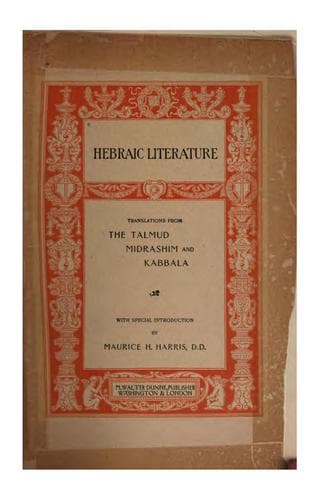
Hebraic Literature; Translations from the Talmud, Midrashim and Kabbala
Religion
Hebraic Literature; Translations from the Talmud, Midrashim and Kabbala
Hebrew literature -- Translations into English
The Rabbis teach that if a man live with a wife ten years without issue
he should divorce her and give her the prescribed marriage portion, as
he may not be deemed worthy to be built up by her (that is, to have
children by her).
Ibid., fol. 64, col. 2.
As a set-off we append here a romantic story paraphrased from
the Midrash Shir Hashirim. A certain Israelite of Sidon, having
lived many years with his wife without being blessed with
offspring, made up his mind to give her a bill of divorcement.
They went accordingly together to Rabbi Shimon ben Yochai, that
legal effect might be given to the act of separation. Upon
presenting themselves before him, the Rabbi addressed them in
these fatherly accents:--"My children," said he, "your divorce
must not take place in pettishness or anger, lest people should
surmise something guilty or disgraceful as the motive for the
action. Let your parting, therefore, be like your meeting,
friendly and cheerful. Go home, make a feast, and invite your
friends to share it with you; and then to-morrow return and I
will ratify the divorce you seek for." Acting upon this advice,
they went home, got ready a feast, invited their friends, and
made merry together. "My dear," said the husband at length to
his wife, "we have lived for many a long year lovingly together,
and now that we are about to be separated, it is not because
there is any ill-will between us, but simply because we are not
blessed with a family. In proof that my love is unchanged, and
that I wish thee all good, I give thee leave to choose whatever
thou likest best in the house and carry it away with thee." The
wife with true womanly wit promptly replied, "Well and good, my
dear!" The evening thereafter glided pleasantly by, the wine-cup
went round freely and without stint, and all passed off well,
till first the guests one by one, and then the master of the
house himself, fell asleep, and lay buried in unconsciousness.
The lady, who had planned this result, and only waited its
_denouement_, immediately summoned her confidential handmaids
and had her lord and master gently borne away as he was to the
house of her father. On the following morning, as the stupor
wore off, he awoke, rubbing his eyes with astonishment. "Where
am I?" he cried. "Be easy, husband dear," responded the wife in
his presence. "I have only done as thou allowedst me. Dost thou
remember permitting me last night, in the hearing of our guests,
to take away from our house whatever best pleased me? There was
nothing there I cared for so much as thyself; thou art all in
all to me, so I brought thee with me here. Where I am there
shalt thou be; let nothing but death part us." The two thereupon
went back to Rabbi Shimon as appointed, and reported their
change of purpose, and that they had made up their minds to
remain united.
Public-domain text, read in full here on John Shaqi.
Reviews
Reviews
No reviews yet
Be the first to share your thoughts on this work.
Elsewhere in the archive
Join the Discussion
Join the discussion
Sign in to leave a comment or review.
Sign InorCreate an account