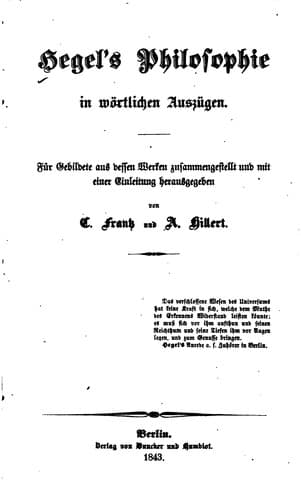
Hegel's Lectures on the History of Philosophy: Volume 3 (of 3)Hegel, Georg Wilhelm Friedrich
PhilosophyPhilosophy
Hegel's Lectures on the History of Philosophy: Volume 3 (of 3)
Hegel, Georg Wilhelm Friedrich
Philosophy -- History
Bruno here asks the question: “But this first universal form and that
first universal matter, how are they united, inseparable? Different—and
yet one Being?” He answers by making use of the Aristotelian forms of
δύναμις and ἐνέργεια: Matter is to be regarded as potentiality; in this
way all possible forms of existence in a certain sense are included
in the Notion of it. The passivity of matter must be regarded as pure
and absolute. Now it is impossible to attribute existence to a thing
which lacks the power to exist. Existence has, however, such an express
reference to the active mode, that it is at once clear that the one
cannot exist without the other, but that each of them presupposes the
other. If therefore at all times a capacity of working, producing,
creating, was there, so must there also have been at all times a capacity
of being worked upon, produced, created. The perfect potentiality of
the existence of things (matter) cannot precede their actual existence,
and just as little can it remain after that is past. The first and
most perfect principle includes all existence in itself, can be all
things, and is all things. Active power and potentiality, possibility
and actuality are therefore in it one undivided and indivisible
principle.[77] This simultaneousness of acting and being acted upon is a
very important determination; matter is nothing without activity, form
is therefore the power and inward life of matter. If matter were nothing
but indeterminate potentiality, how would the determinate be arrived at?
This simplicity of matter is itself only one moment of form: in wishing
therefore to tear asunder matter and form, matter is at once established
in one determination of form, but in so doing there is immediately
established also the existence of the Other.
Thus the Absolute is determined for Bruno: it is not so with other
things, which may exist and also may not exist, and which may be
determined in one way or in another way. In regard to finite things and
in finite determinations of the understanding the distinction between
form and matter is thus present. The individual man is at every moment
what he may be at that moment, but not everything which he may be in
general and with reference to substance. The things which appear to be
different are only modifications of one single thing which includes in
its existence all other existence. The universe, unbegotten Nature, is,
however, everything which it can be in reality and at one time, because
it includes in itself the whole of matter, as well as the eternal,
unchangeable form of its changing forms. But in its developments from
moment to moment, its particular parts, qualities, individual existences,
in its externality as a whole, it is no more what it is and may be;
but a part such as this is only a shadow of the image of the first
principle.[78] Thus Bruno wrote also a book, _De umbris idearum_.
Public-domain text, read in full here on John Shaqi.
Reviews
Reviews
No reviews yet
Be the first to share your thoughts on this work.
Elsewhere in the archive
Join the Discussion
Join the discussion
Sign in to leave a comment or review.
Sign InorCreate an account