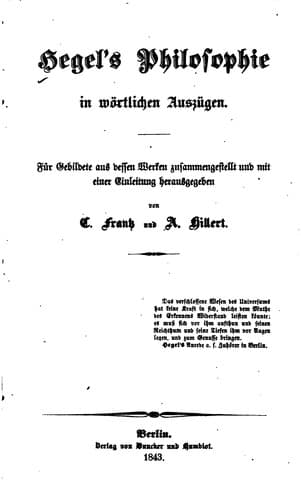
Hegel's Lectures on the History of Philosophy: Volume 3 (of 3)Hegel, Georg Wilhelm Friedrich
PhilosophyPhilosophy
Hegel's Lectures on the History of Philosophy: Volume 3 (of 3)
Hegel, Georg Wilhelm Friedrich
Philosophy -- History
Now this principle was at first grasped in relation to religious objects
only, and thereby it has indeed received its absolute justification,
but still it has not been extended to the further development of the
subjective principle itself. Yet in so far as man has come to the
consciousness of being reconciled to himself, and of only being able to
reconcile himself in his personal existence, he has in his actuality
likewise attained another form. The otherwise hearty and vigorous man may
also, in as far as he enjoys, do so with a good conscience; the enjoyment
of life for its own sake is no longer regarded as something which is to
be given up, for monkish renunciation is renounced. But to any other
content the principle did not at first extend. Yet further, the religious
content has more specially been apprehended as concrete, as it is for
the recollection, and into this spiritual freedom the beginning and the
possibility of an unspiritual mode of regarding things has thus entered.
The content of the _Credo_, speculative as it is in itself, has, that is
to say, an historical side. Within this barren form the old faith of the
church has been admitted and allowed to exist, so that in this form it
has to be regarded by the subject as the highest truth. The result then
follows that all development of the dogmatic content in a speculative
manner is quite set aside. What was required is man’s inward assurance of
his deliverance, of his salvation—the relation of the subjective spirit
to the absolute, the form of subjectivity as aspiration, repentance,
conversion. This new principle has been laid down as paramount, so
that the content of truth is clearly of importance; but the teaching
respecting the nature and the process of God is grasped in the form in
which it at first appears for the ordinary conception. Not only have all
this finality, externality, unspirituality, this formalism of scholastic
philosophy, been on the one hand discarded, and with justice, but, on
the other, the philosophic development of the doctrines of the church
has been also set aside, and this is done in connection with the very
fact that the subject is immersed in his own heart. This immersion, his
penitence, contrition, conversion, this occupation of the subject with
himself, has become the moment of first importance; but the subject has
not immersed himself in the content, and the earlier immersion of spirit
therein has also been rejected. Even to this present day we shall find
in the Catholic Church and in her dogmas the echoes, and so to speak
the heritage of the philosophy of the Alexandrian school; in it there
is much more that is philosophic and speculative than in the dogmatism
of Protestantism, even if there is still in this an objective element,
and if it has not been made perfectly barren, as though the content were
really retained only in the form of history. The connection of Philosophy
with the theology of the Middle Ages has thus in the Catholic Church
Public-domain text, read in full here on John Shaqi.
Reviews
Reviews
No reviews yet
Be the first to share your thoughts on this work.
Elsewhere in the archive
Join the Discussion
Join the discussion
Sign in to leave a comment or review.
Sign InorCreate an account