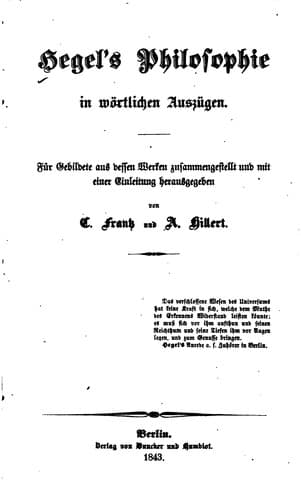
Hegel's Lectures on the History of Philosophy: Volume 3 (of 3)Hegel, Georg Wilhelm Friedrich
PhilosophyPhilosophy
Hegel's Lectures on the History of Philosophy: Volume 3 (of 3)
Hegel, Georg Wilhelm Friedrich
Philosophy -- History
Pure thought is likewise one form of inwardness; it also approaches
absolute existence and finds itself justified in apprehending the same.
The philosophy of modern times proceeds from the principle which ancient
philosophy had reached, the standpoint of actual self-consciousness—it
has as principle the spirit that is present to itself; it brings the
standpoint of the Middle Ages, the diversity between what is thought
and the existent universe, into opposition, and it has to do with the
dissolution of this same opposition. The main interest hence is, not so
much the thinking of the objects in their truth, as the thinking and
understanding of the objects, the thinking this unity itself, which is
really the being conscious of a presupposed object. The getting rid of
the formal culture of the logical understanding and the monstrosities
of which it was composed, was more essential than the extension of it:
investigation in such a case becomes dissipated and diffused, and passes
into the false infinite. The general points of view which in modern
philosophy we reach are hence somewhat as follows:—
1. The concrete form of thought which we have here to consider on its own
account, really appears as subjective with the reflection of implicitude,
so that this has an antithesis in existence; and the interest is then
altogether found in grasping the reconciliation of this opposition in its
highest existence, _i.e._ in the most abstract extremes. This highest
severance is the opposition between thought and Being, the comprehending
of whose unity from this time forward constitutes the interest of all
philosophies. Here thought is more independent, and thus we now abandon
its unity with theology; it separates itself therefrom, just as with the
Greeks it separated itself from mythology, the popular religion, and did
not until the time of the Alexandrians seek out these forms again and
fill the mythological conceptions with the form of thought. The bond
remains, but for this reason it is clearly implicit: theology throughout
is merely what philosophy is, for this last is simply thought respecting
it. It does not help theology to strive against philosophy, or to say
that it wishes to know nothing about it, and that philosophic maxims
are thus to be set aside. It has always to do with the thought that it
brings along with it, and these its subjective conceptions, its home and
private metaphysics, are thus frequently a quite uncultured, uncritical
thought—the thought of the street. These general conceptions are, indeed,
connected with particular subjective conviction, and this last is said to
prove the Christian content to be true in a sense all its own; but these
thoughts which constitute the criterion are merely the reflections and
opinions which float about the surface of the time. Thus, when thought
comes forth on its own account, we thereby separate ourselves from
theology; we shall, however, consider one other in whom both are still
in unity.
Public-domain text, read in full here on John Shaqi.
Reviews
Reviews
No reviews yet
Be the first to share your thoughts on this work.
Elsewhere in the archive
Join the Discussion
Join the discussion
Sign in to leave a comment or review.
Sign InorCreate an account