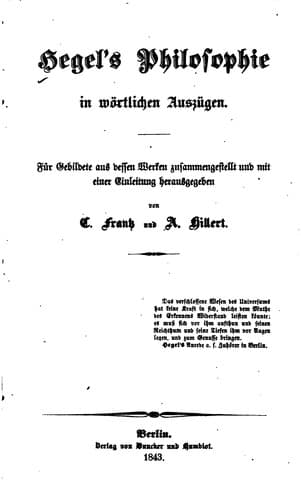
Hegel's Lectures on the History of Philosophy: Volume 3 (of 3)Hegel, Georg Wilhelm Friedrich
PhilosophyPhilosophy
Hegel's Lectures on the History of Philosophy: Volume 3 (of 3)
Hegel, Georg Wilhelm Friedrich
Philosophy -- History
A philosopher, it is said, should live as a
philosopher, _i.e._, should be independent of the external relationships
of the world, and should give up occupying himself with and troubling
himself concerning them. But thus circumscribed in respect of all
necessities, more especially of culture, no one can suffice for himself;
he must seek to act in connection with others. The modern world is this
essential power of connection, and it implies the fact that it is clearly
necessary for the individual to enter into these relations of external
existence; only a common mode of existence is possible in any calling
or condition, and to this Spinoza forms the solitary exception. Thus in
earlier times bravery was individual; while modern bravery consists in
each not acting after his own fashion, but relying on his connection with
others—and this constitutes his whole merit. The calling of philosopher
is not, like that of the monks, an organized condition. Members of
academies of learning are no doubt organized in part, but even a special
calling like theirs sinks into the ordinary commonplace of state or class
relationships, because admission thereinto is outwardly determined. The
real matter is to remain faithful to one’s aims.
SECTION ONE
MODERN PHILOSOPHY IN ITS FIRST STATEMENT
The first two philosophers whom we have to consider are Bacon and
Boehme; there is as complete a disparity between these individuals as
between their systems of philosophy. None the less both agree that mind
operates in the content of its knowledge as in its own domain, and
this consequently appears as concrete Being. This domain in Bacon is
the finite, natural world; in Boehme it is the inward, mystical, godly
Christian life and existence; for the former starts from experience and
induction, the latter from God and the pantheism of the Trinity.
A. BACON.
Public-domain text, read in full here on John Shaqi.
Reviews
Reviews
No reviews yet
Be the first to share your thoughts on this work.
Elsewhere in the archive
Join the Discussion
Join the discussion
Sign in to leave a comment or review.
Sign InorCreate an account