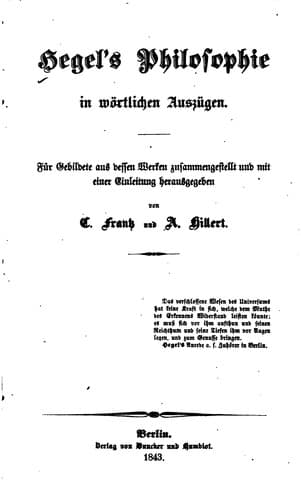
Hegel's Lectures on the History of Philosophy: Volume 3 (of 3)Hegel, Georg Wilhelm Friedrich
PhilosophyPhilosophy
Hegel's Lectures on the History of Philosophy: Volume 3 (of 3)
Hegel, Georg Wilhelm Friedrich
Philosophy -- History
There was already being accomplished the abandonment of the content
which lies beyond us, and which through its form has lost the merit
it possessed of being true, and is become of no significance to
self-consciousness or the certainty of self and of its actuality; this
we see for the first time consciously expressed, though not as yet in a
very perfect form, by Francis Bacon, Baron Verulam, Viscount St. Albans.
He is therefore instanced as in the fore-front of all this empirical
philosophy, and even now our countrymen like to adorn their works with
sententious sayings culled from him. Baconian philosophy thus usually
means a philosophy which is founded on the observation of the external
or spiritual nature of man in his inclinations, desires, rational
and judicial qualities. From these conclusions are drawn, and general
conceptions, laws pertaining to this domain, are thus discovered. Bacon
has entirely set aside and rejected the scholastic method of reasoning
from remote abstractions and being blind to what lies before one’s eyes.
He takes as his standpoint the sensuous manifestation as it appears to
the cultured man, as the latter reflects upon it; and this is conformable
to the principle of accepting the finite and worldly as such.
Bacon was born in London in 1561. His progenitors and relatives held
high office in the state, and his father was Keeper of the Great Seal
to Queen Elizabeth. He in his turn, having been educated to follow the
same vocation, at once devoted himself to the business of the state, and
entered upon an important career. He early displayed great talent, and
at the age of nineteen he produced a work on the condition of Europe
(_De statu Europæ_). Bacon in his youth attached himself to the Earl of
Essex, the favourite of Elizabeth, through whose support he, who as a
younger son had to see his paternal estate pass to his elder brother,
soon attained to better circumstances, and was elevated to a higher
position. Bacon, however, sullied his fame by the utmost ingratitude
and faithlessness towards his protector; for he is accused of having
been prevailed upon by the enemies of the Earl after his fall to charge
him publicly with High Treason. Under James I., the father of Charles
I. who was beheaded, a weak man, to whom he recommended himself by his
work _De augmentis scientiarum_, he received the most honourable offices
of state by attaching himself to Buckingham: he was made Keeper of the
Great Seal, Lord Chancellor of England, Baron Verulam. He likewise made a
rich marriage, though he soon squandered all his means, and high though
his position was, he stooped to intrigues and was guilty of accepting
bribes in the most barefaced manner. Thereby he brought upon himself the
ill-will both of people and of nobles, so that he was prosecuted, and
his case was tried before Parliament. He was fined 40,000_l._, thrown
into the Tower, and his name was struck out of the list of peers; during
Public-domain text, read in full here on John Shaqi.
Reviews
Reviews
No reviews yet
Be the first to share your thoughts on this work.
Elsewhere in the archive
Join the Discussion
Join the discussion
Sign in to leave a comment or review.
Sign InorCreate an account