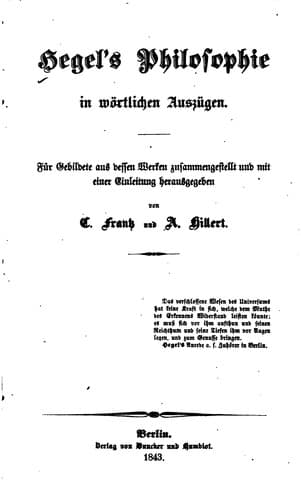
Hegel's Lectures on the History of Philosophy: Volume 3 (of 3)Hegel, Georg Wilhelm Friedrich
PhilosophyPhilosophy
Hegel's Lectures on the History of Philosophy: Volume 3 (of 3)
Hegel, Georg Wilhelm Friedrich
Philosophy -- History
1. Bacon’s fame rests on two works. In the first place, he has the
merit of having in his work _De augmentis scientiarum_ presented to
us a systematic encyclopedia of the sciences, an outline which must
undoubtedly have caused a sensation amongst his contemporaries. It is
important to set before men’s eyes a well arranged picture such as
this of the whole, when that whole has not been grasped in thought.
This encyclopedia gives a general classification of the sciences; the
principles of the classification are regulated in accordance with the
differences in the intellectual capacities. Bacon thus divides human
learning according to the faculties of memory, imagination, and reason,
for he distinguishes what pertains (1) to memory; (2) to imagination; (3)
to reason. Under memory he considered history; under imagination, poetry,
and art; and finally, under reason, philosophy.[97] According to his
favourite method of division these again are further divided, since he
brings all else under these same heads; this is, however, unsatisfactory.
To history belong the works of God—sacred, prophetic, ecclesiastical
history; the works of men—civil and literary history; and likewise the
works of nature, and so on.[98] He goes through these topics after the
manner of his time, a main characteristic of which is that anything can
be made plausible through examples, _e.g._ from the Bible. Thus, in
treating of _Cosmetica_, he says in regard to paint that “He is surprised
that this depraved custom of painting has been by the penal laws both
ecclesiastical and civil so long overlooked. In the Bible we read indeed
of Jezebel that she painted her face; but nothing of the kind is said
of Esther or Judith.”[99] If kings, popes, etc., are being discussed,
such examples as those of Ahab and Solomon must be brought forward. As
formerly in civil laws—those respecting marriage, for instance—the Jewish
forms held good, in Philosophy, too, the same are still to be found. In
this work theology likewise appears, as also magic; there is contained in
it a comprehensive system of knowledge and of the sciences.
Public-domain text, read in full here on John Shaqi.
Reviews
Reviews
No reviews yet
Be the first to share your thoughts on this work.
Elsewhere in the archive
Join the Discussion
Join the discussion
Sign in to leave a comment or review.
Sign InorCreate an account