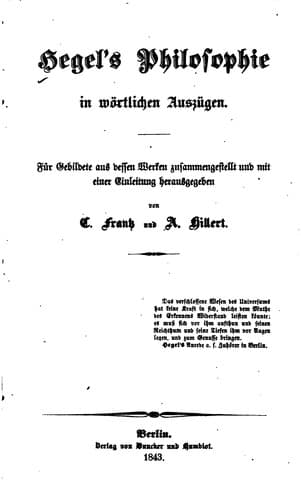
Hegel's Lectures on the History of Philosophy: Volume 3 (of 3)Hegel, Georg Wilhelm Friedrich
PhilosophyPhilosophy
Hegel's Lectures on the History of Philosophy: Volume 3 (of 3)
Hegel, Georg Wilhelm Friedrich
Philosophy -- History
The second point then is that the sensuous and present form must
disappear, so that it may be taken into the Mnemosyne, into the realm
of popular conception; then for the first time can the spiritual
consciousness, the spiritual relation, enter in. To the question of
whither Christ has gone, the answer is given, “He sits on the right hand
of God,” which signifies that it is only now that God can be known as
this concrete One, as the One who has the other moment, His Son (λόγος,
σοφία), in Himself. Thus to know what is the principle of Christianity as
truth, the truth of the Idea of spirit must be known as concrete spirit,
and this is the form peculiar to the Fathers of the Church. With this
the idea that the abstractly divine breaks up and has broken up within
itself, first began to appear. This other moment in the divine must
not, however, be grasped in the mode of an intelligible world, or, as
we certainly have it in the ordinary conception, of a kingdom of heaven
with many angels, who are also finite, limited, thus approaching closer
to humanity. But it is not sufficient that the concrete moment should be
known in God, for the further knowledge is requisite that Christ is an
actual present man. This moment of Christ’s actual present humanity is of
immense importance to Christianity, because it is the union of the most
tremendous opposites. This higher conception could not have been present
in the text, in the first manifestation; the greatness of the Idea could
only come in later on, after the Spirit had perfected the Idea.
That the revelation of Christ has this significance is the belief of
Christians, while the profane, immediate and direct significance of
this history is that Christ was a mere prophet and met the fate of
all the prophets in being misunderstood. But the fact that it has the
significance given by us is known through the Spirit, for the Spirit is
revealed in this history. This history is the Notion, the Idea of Spirit
itself, and the world-history has in it found its end, which is in this
immediate way to know the truth. It is therefore the Spirit which so
comprehends that history, and at the time of Pentecost this is shown in
an immediate and evident manner. For before this time the Apostles did
not know the infinite significance of Christ; they did not yet know that
this is the infinite history of God; they had believed in Him, but not
yet as seeing in Him this infinite truth.
Public-domain text, read in full here on John Shaqi.
Reviews
Reviews
No reviews yet
Be the first to share your thoughts on this work.
Join the Discussion
Join the discussion
Sign in to leave a comment or review.
Sign InorCreate an account