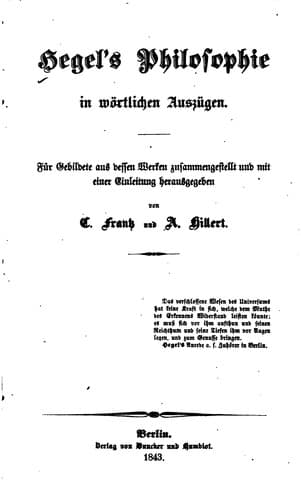
Hegel's Lectures on the History of Philosophy: Volume 3 (of 3)Hegel, Georg Wilhelm Friedrich
PhilosophyPhilosophy
Hegel's Lectures on the History of Philosophy: Volume 3 (of 3)
Hegel, Georg Wilhelm Friedrich
Philosophy -- History
the case that it is different in respect of other things.
Fifthly: These representations and ideas are not necessarily conscious
representations and ideas, any more than all monads as forming
representations are conscious. It is true that consciousness is itself
perception, but a higher grade of the same; perceptions of consciousness
Leibnitz calls apperceptions. The difference between the merely
representing and the self-conscious monads Leibnitz makes one of degrees
of clearness. The expression representation has, however, certainly
something awkward about it, since we are accustomed to associate it only
with consciousness, and with consciousness as such; but Leibnitz admits
also of unconscious representation. When he then adduces examples of
unconscious representations, he appeals to the condition of a swoon or
of sleep, in which we are mere monads: and that representations without
consciousness are present in such states he shows from the fact of our
having perceptions immediately after awakening out of sleep, which shows
that others must have been there, for one perception arises only out of
others.[252] That is a trivial and empirical demonstration.
Sixthly: These monads constitute the principle of all that exists. Matter
is nothing else than their passive capability. This passive capability it
is which constitutes the obscurity of the representations, or a confusion
which never arrives at distinction, or desire, or activity.[253] That
is a correct definition of the conception; it is Being, matter, in
accordance with the moment of simplicity. This is implicitly activity;
“mere implicitness without actualization” would therefore be a better
expression. The transition from obscurity to distinctness Leibnitz
exemplifies by the state of swooning.
Seventhly: Bodies as bodies are aggregates of monads: they are mere heaps
which cannot be termed substances, any more than a flock of sheep can
bear this name.[254] The continuity of the same is an arrangement or
extension, but space is nothing in itself;[255] it is only in another,
or a unity which our understanding gives to that aggregate.[256]
b. Leibnitz goes on to determine and distinguish more clearly as the
principal moments, inorganic, organic, and conscious monads, and he does
it in the following way.
Public-domain text, read in full here on John Shaqi.
Reviews
Reviews
No reviews yet
Be the first to share your thoughts on this work.
Elsewhere in the archive
Join the Discussion
Join the discussion
Sign in to leave a comment or review.
Sign InorCreate an account