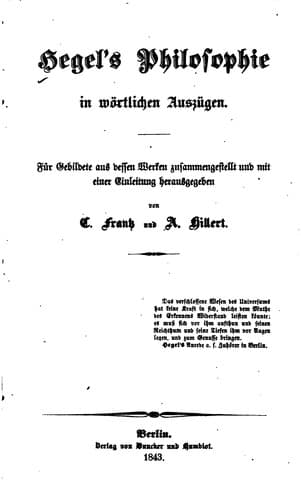
Hegel's Lectures on the History of Philosophy: Volume 3 (of 3)Hegel, Georg Wilhelm Friedrich
PhilosophyPhilosophy
Hegel's Lectures on the History of Philosophy: Volume 3 (of 3)
Hegel, Georg Wilhelm Friedrich
Philosophy -- History
γ. The conscious monad distinguishes itself from the naked (material)
monads by the distinctness of the representation. But this is of course
only an indefinite word, a formal distinction; it indicates that
consciousness is the very thing that constitutes the distinction of the
undistinguished, and that distinction constitutes the determination
of consciousness. Leibnitz more particularly defined the distinction
of man as that “he is capable of the knowledge of necessary and
eternal truths,”—or that he conceives the universal on the one hand,
and on the other what is connected with it; the nature and essence of
self-consciousness lies in the universality of the Notions. “These
eternal truths rest on two maxims; the one is that of contradiction,
the other is that of sufficient reason.” The former of these is unity
expressed in useless fashion as a maxim, the distinction of the
undistinguishable, A = A; it is the definition of thinking, but not a
maxim which could contain a truth as content, or it does not express
the Notion of distinction as such. The other important principle
was, on the other hand: What is not distinguished in thought is
not distinguished (p. 333). “The maxim of the reason is that
everything has its reason,”[260]—the particular has the universal
as its essential reality. Necessary truth must have its reason in
itself in such a manner that it is found by analysis, _i.e._ through
that very maxim of identity. For analysis is the very favourite
plan of resolving into simple ideas and principles: a resolution
which annihilates their relation, and which therefore in fact
forms a transition into the opposite, though it does not have the
consciousness of the same, and on that account also excludes the
Notion; for every opposite it lays hold of only in its identity.
Sufficient reason seems to be a pleonasm; but Leibnitz understood by
this aims, final causes (_causæ finales_), the difference between
which and the causal nexus or the efficient cause he here brings under
discussion.[261]
c. The universal itself, absolute essence, which with Leibnitz is
something quite different from the monads, separates itself also into two
sides, namely universal Being and Being as the unity of opposites.
Public-domain text, read in full here on John Shaqi.
Reviews
Reviews
No reviews yet
Be the first to share your thoughts on this work.
Elsewhere in the archive
Join the Discussion
Join the discussion
Sign in to leave a comment or review.
Sign InorCreate an account