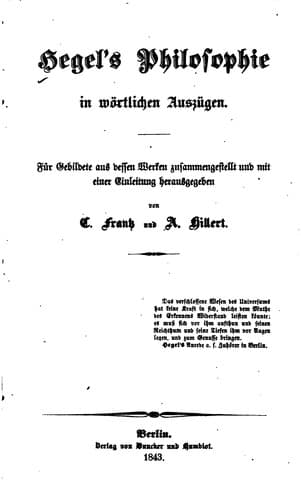
Hegel's Lectures on the History of Philosophy: Volume 3 (of 3)Hegel, Georg Wilhelm Friedrich
PhilosophyPhilosophy
Hegel's Lectures on the History of Philosophy: Volume 3 (of 3)
Hegel, Georg Wilhelm Friedrich
Philosophy -- History
in which spirit is found as actual, present spirit, immediately existent
in the world here and now, and the absolute spirit is known in the
immediate present as man.
In order to grasp and apply the Idea of Christianity, the philosophic
Idea of which we have already spoken in connection with the
Neo-Platonists must have been comprehended for itself; but within
Christianity the basis of Philosophy is that in man has sprung up the
consciousness of the truth, or of spirit in and for itself, and then
that man requires to participate in this truth. Man must be qualified
to have this truth present to him; he must further be convinced of this
possibility. This is the absolute demand and necessity; the consciousness
must be arrived at that this alone is true. The first point of interest
in the Christian religion thus is that the content of the Idea should
be revealed to man; more particularly that the unity of the divine
and human nature should come to the consciousness of man, and that,
indeed, on the one hand as an implicitly existent unity, and, on the
other, in actuality as worship. The Christian life signifies that the
culminating point of subjectivity is made familiar with this conception,
the individual himself is laid claim to, is made worthy of attaining on
his own account to this unity, which is to make himself worthy of the
Spirit of God—Grace, as it is called—dwelling in him. Hence the doctrine
of reconciliation is that God is known as reconciling Himself with the
world, _i.e._ as we have seen in the Neo-Platonic philosophy, that He
particularizes Himself and does not remain abstract. Not external nature
alone, but the whole world pertains to the particular; above all must
human individuality know itself in God. The interest of the subject
is itself involved, and here it plays an essential rôle in order that
God may be realized and may realize Himself in the consciousness of
individuals who are spirit and implicitly free. Thus through the process
these accomplish that reconciliation in themselves, actualize their
freedom; that is to say, they attain to the consciousness of heaven upon
earth, the elevation of man to God. Thus the true intellectual world
is not a beyond, but the so-called finite is an element in it, and no
division exists between this side and that. The real concrete in regard
to the absolute Idea is the knowing of the mundane, the ‘other’ in God,
as implicitly divine, as universal, as the world of intellect, as having
its root in God, but only the root. In God man is accepted only in his
truth, and not in his immediacy, and thus this doctrine is not what we
call Pantheism, for that leaves the immediate just as it is. Man then
has himself to accomplish the process of reconciliation in himself in
order to attain to his truth. We have thus seen that man possesses the
determination and attributes of God as the first begotten son, Adam
Kadmon, the first man; we may call this unity the concrete Idea, which,
Public-domain text, read in full here on John Shaqi.
Reviews
Reviews
No reviews yet
Be the first to share your thoughts on this work.
Join the Discussion
Join the discussion
Sign in to leave a comment or review.
Sign InorCreate an account