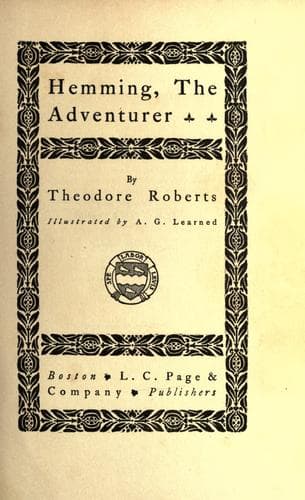
Hemming, the adventurerRoberts, Theodore Goodridge
General
Hemming, the adventurer
Roberts, Theodore Goodridge
Canadian fiction -- 20th century
"It is all over between us," sobbed the girl, and beyond that she
could learn nothing. Having failed to receive information, she
immediately began to impart some, and told what Mr. Pollin had heard
from Major O'Grady. Molly, who lay on the bed, kept her face buried
in the pillow, and showed no signs of hearing anything. At last her
mother left her, after saying that she would send her dinner up to
her. The bewildered woman had never felt quite so put about since
the death of the lord bishop. Could it be, she wondered, that she
had made a mistake in encouraging Harry Penthouse's work tearing down
Molly's belief in Hemming? Even her dinner did not altogether
reassure her troubled spirit.
Several days later Miss Travers wrote to Hemming. It contained only
a line or two. It begged his forgiveness. It called him to return
and let her show her love. She sent it to his old address in Dublin,
and in the corner wrote "Please forward."
[Illustration: "SEVERAL DAYS LATER MISS TRAVERS WROTE TO HEMMING"]
Now it happened that Private Malloy, who had once been Captain
Hemming's orderly, was sent one day, by a sergeant, for the officers'
mail. He thought himself a sly man, did Mr. Malloy, and when he
found a letter addressed to his late beloved master, in a familiar
handwriting, he decided that it was from "one of them dunnin' Jews,"
and carefully separated it from the pile. Later he burned it. "One
good turn deserves another," said he, watching the thin paper flame
and fade.
Penthouse returned to his regiment without calling again on Molly and
Mrs. Travers. Somehow, after the beating he had received, he did not
feel like showing his face anywhere in town. Day after day Molly
waited for an answer to her letter. By this time she had heard, from
Captain Anderson (who had acted nervously during his short call), of
Hemming's intention of going immediately to Greece. So for two weeks
she waited hopefully. Then the horrible fear that she had hurt him
beyond pardoning, perhaps even disgusted him, grew upon her. But for
more than a month every brisk footfall on the pavement and every ring
at the door-bell set her heart burning and left it throbbing with
pain.
When she drove with her mother she scanned the faces of the men in
the street, and often and often she changed colour at sight of a
thin, alert face or broad, gallant shoulders in the crowd.
Captain Anderson was at Aldershot when he received his friend's
letter from Jamaica. He went up to town and called on Miss Travers,
and, without so much as "by your leave," read her extracts from the
letter. She listened quietly, with downcast eyes and white face.
When he was through with it she looked at him kindly; but her eyes
were dim.
"Why do you taunt me?" she asked. "Is it because you are his
friend?" The smile that followed the question was not a happy one.
The sapper's honest face flamed crimson. "I thought you wanted to
know about him," he stammered.
Public-domain text, read in full here on John Shaqi.
Reviews
Reviews
No reviews yet
Be the first to share your thoughts on this work.
Join the Discussion
Join the discussion
Sign in to leave a comment or review.
Sign InorCreate an account