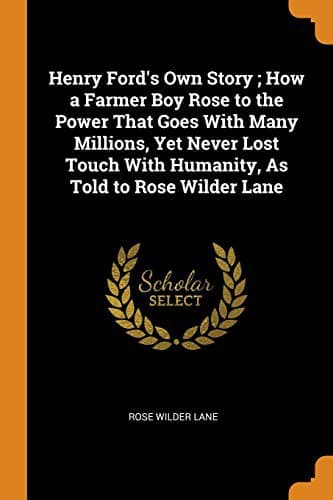
Henry Ford's Own Story: How a Farmer Boy Rose to the Power that goes with Many Millions, Yet Never Lost Touch with Humanity — John Shaqi
Henry Ford's Own Story: How a Farmer Boy Rose to the Power that goes with Many Millions, Yet Never Lost Touch with HumanityLane, Rose Wilder
Philosophy
Henry Ford's Own Story: How a Farmer Boy Rose to the Power that goes with Many Millions, Yet Never Lost Touch with Humanity
Lane, Rose Wilder
Automobile industry and trade -- United States -- History; Businesspeople -- United States -- Biography; Ford, Henry, 1863-1947
"I never did figure out how to spend the whole of that dollar," he says.
"I really had no use for it. My board and lodging were paid and the
clothes I had were good enough for the shop. I never have known what to
do with money after my expenses were paid--can't squander it on myself
without hurting myself, and nobody wants to do that. Money is the most
useless thing in the world, anyhow."
His life now settled into a routine eminently satisfactory to him--a
routine that lasted for nine months. From seven in the morning to six at
night in the machine shop, from seven to eleven in the evening at work
with a microscope, repairing and assembling watches, then home to bed
for a good six hours' sleep, and back to work again.
Day followed day, exactly alike, except that every one of them taught
him something about machines--either steam engines or watches. He went
to bed, rose, ate, worked on a regular schedule, following the same
route--the shortest one--from the boarding-house to the shops, to the
jeweler's, back to the boarding-house again.
Before long he found that he could spend a part of his dollar profitably
in buying technical journals--French, English, German magazines dealing
with mechanics. He read these in his room after returning from the
jeweler's.
Few boys of sixteen could endure a routine so exacting in its demands on
strength and endurance without destroying their health, but Henry Ford
had the one trait common to all men of achievement--an apparently
inexhaustible energy. His active, out-of-door boyhood had stored up
physical reserves of it; his one direct interest gave him his mental
supply. He wanted to learn about machines; that was all he wanted. He
was never distracted by other impulses or tastes.
"Recreation? No, I had no recreation; I didn't want it," he says.
"What's the value of recreation, anyhow? It's just waste time. I got my
fun out of my work."
He was obsessed by his one idea.
In a few months he had mastered all the intricate details of building
steam engines. The mammoth shop of James Flower & Co., with its great
force of a hundred mechanics, became familiar to him; it shrank from the
huge proportions it had at first assumed in his eyes. He began to see
imperfections in its system and to be annoyed by them.
"See here," he said one day to the man who worked beside him. "Nothing's
ever made twice alike in this place. We waste a lot of time and material
assembling these engines. That piston rod'll have to be made over; it
won't fit the cylinder."
"Oh, well, I guess we do the best we can," the other man said. "It won't
take long to fit it." It was the happy-go-lucky method of factories in
the seventies.
Public-domain text, read in full here on John Shaqi.
Reviews
Reviews
No reviews yet
Be the first to share your thoughts on this work.
Join the Discussion
Join the discussion
Sign in to leave a comment or review.
Sign InorCreate an account