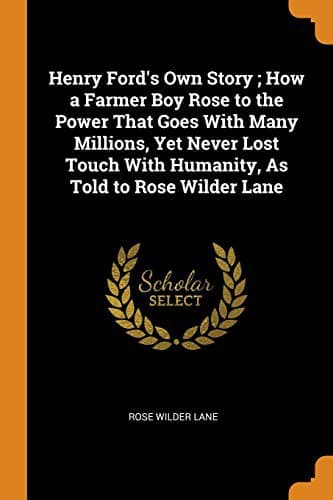
Henry Ford's Own Story: How a Farmer Boy Rose to the Power that goes with Many Millions, Yet Never Lost Touch with HumanityLane, Rose Wilder
Philosophy
Henry Ford's Own Story: How a Farmer Boy Rose to the Power that goes with Many Millions, Yet Never Lost Touch with Humanity
Lane, Rose Wilder
Automobile industry and trade -- United States -- History; Businesspeople -- United States -- Biography; Ford, Henry, 1863-1947
It was on the whole a busy, happy childhood, spent for the most part out
of doors. Henry grew freckled, sunburned the skin from his nose and neck
in the swimming pool, scratched his bare legs on blackberry briars. He
learned how to drive horses, how to handle a hay fork or a hoe, how to
sharpen and repair the farm tools. The "shop" was the most interesting
part of the farm to him; it was there he invented and manufactured a
device for opening and closing the farm gates without getting down from
the wagon.
Then, when he was 14, an event occurred which undoubtedly changed the
course of his life. Mary Ford died.
CHAPTER III
THE FIRST JOB
When Mary Ford died the heart of the home went with her. "The house was
like a watch without a mainspring," her son says. William Ford did his
best, but it must have been a pathetic attempt, that effort of the big,
hardworking farmer to take a mother's place to the four children.
For a time a married aunt came in and managed the household, but she was
needed in her own home and soon went back to it. Then Margaret, Henry's
youngest sister, took charge, and tried to keep the house in order and
superintend the work of "hired girls" older than herself. She was
"capable"--that good New England word so much more expressive than
"efficient"--but no one could take Mary Ford's place in that home.
There was now nothing to hold Henry on the farm. He had learned how to
do the farm work, and the little attraction it had had for him was gone;
thereafter every task was merely a repetition. His father did not need
his help; there were always the hired men. I suppose any need William
Ford may have felt for the companionship of his second son was
unexpressed. In matters of emotion the family is not demonstrative.
The boy had exhausted the possibilities of the farm shop. His last work
in it was the building of a small steam-engine. For this, helped partly
by pictures, partly by his boyish ingenuity, he made his own patterns,
his own castings, did his own machine work.
His material was bits of old iron, pieces of wagon tires, stray teeth
from harrows--anything and everything from the scrap pile in the shop
which he could utilize in any imaginable way. When the engine was
finished Henry mounted it on an improvised chassis which he had cut down
from an old farm wagon, attached it by a direct drive to a wheel on one
side, something like a locomotive connecting-rod, and capped the whole
with a whistle which could be heard for miles.
When he had completed the job he looked at the result with some natural
pride. Sitting at the throttle, tooting the ear-splitting whistle, he
charged up and down the meadow lot at nearly ten miles an hour,
frightening every cow on the place. But after all his work, for some
reason the engine did not please him long. Possibly the lack of
enthusiasm with which it was received disappointed him.
Public-domain text, read in full here on John Shaqi.
Reviews
Reviews
No reviews yet
Be the first to share your thoughts on this work.
Join the Discussion
Join the discussion
Sign in to leave a comment or review.
Sign InorCreate an account