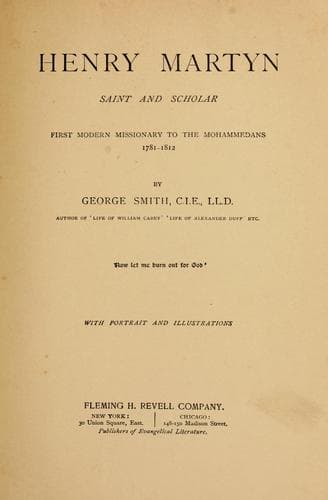
The Persians, who were struck with his humility, his patience
and resignation, called him a _merdi khodai_, a man of God, and
indeed every action of his life seemed to be bent towards the
one object of advancing the interest of the Christian religion.
When he was living at Shiraz, employed in his translation, he
neither sought nor shunned the society of the natives, many of
whom constantly drew him into arguments about religion, with the
intention of persuading him of the truth and excellence of
theirs. His answers were such as to stimulate them to further
arguments, and in spite of their pride the principal moollahs,
who had heard of his reputation, paid him the first visit, and
endeavoured in every way to entangle him in his talk. At length
he thought that the best mode of silencing them was by writing a
reply to the arguments which they brought against our belief and
in favour of their own. His tract was circulated through
different parts of Persia, and was sent from hand to hand to be
answered. At length it made its way to the King's court, and a
moollah of high consideration, who resided at Hamadan, and who
was esteemed one of the best controversialists in the country,
was ordered to answer it. After the lapse of more than a year he
did answer it, but such were the strong positions taken by Mr.
Martyn that the Persians themselves were ashamed of the futility
of their own attempts to break them down: for, after they had
sent their answer to the ambassador, they requested that it
might be returned to them again, as another answer was preparing
to be given. Such answer has never yet been given; and we may
infer from this circumstance that if, in addition to the
Scriptures, some plain treatises of the evidences of
Christianity, accompanied by strictures upon the falseness of
the doctrines of Mohammed, were translated into Persian and
disseminated throughout that country, very favourable effects
would be produced. Mr. Martyn caused a copy of his translation
to be beautifully written, and to be presented by the ambassador
to the King, who was pleased to receive it very graciously. A
copy of it was made by Mirza Baba, a Persian who gave us lessons
in the Persian language, and he said that many of his countrymen
asked his permission to take Mr. Martyn's translation to their
homes, where they kept it for several days, and expressed
themselves much edified by its contents. But whilst he was
employed in copying it, moollahs (the Persian scribes) used
frequently to sit with him and revile him for undertaking such a
work. On reading the passage where our Saviour is called 'the
Lamb of God,' they scorned and ridiculed the simile, as if
exulting in the superior designation of Ali, who is called
_Sheer_ Khodai, the Lion of God. Mirza Baba observed to them:
Public-domain text, read in full here on John Shaqi.
Reviews
Reviews
No reviews yet
Be the first to share your thoughts on this work.
Elsewhere in the archive
Join the Discussion
Join the discussion
Sign in to leave a comment or review.
Sign InorCreate an account