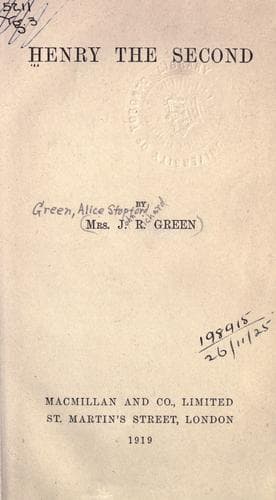
Great Britain -- History -- Henry II, 1154-1189; Henry II, King of England, 1133-1189
In England the king's power knew no limits. Rebellion had been finally
crushed. His wife and sons were held in check. He had practically won a
victory over the Church. Even in renouncing the Constitutions of
Clarendon at Avranches Henry abandoned more in word than in deed. He
could still fall back on the law of the land and the authority which he
had inherited from the Norman kings. Since the Conqueror's days no Pope
might be recognized as Apostolic Pope save at the king's command; no
legate might land or use any power in England without the king's
consent; no ecclesiastical senate could decree laws which were not
authorized by the king, or could judge his servants against his will.
The king could effectually resist the introduction of foreign canon law;
he could control communications with Rome; he could stay the proceedings
of ecclesiastical courts if they went too far, or prejudiced the rights
of his subjects; and no sentence could be enforced save by his will.
Henry was strong enough only six years after the death of Thomas to win
control over a vast amount of important property by insisting that
questions of advowson should be tried in the secular courts, and that
the murderers of clerks should be punished by the common law. He was
able in effect to prevent the Church courts from interfering in secular
matters save in the case of marriages and of wills. He preserved an
unlimited control over the choice of bishops. In an election to the see
of St. David's the canons had neglected to give the king notice before
the nomination of the bishop. He at once ordered them to be deprived of
their lands and revenues. "As they have deprived me," he said, "of all
share in the election, they shall have neither part nor lot in this
promotion." The monks, stricken with well-founded terror, followed the
king from place to place to implore his mercy and to save their livings;
with abject repentance they declared they would accept whomsoever the
king liked, wherever and whenever he chose. Finally Henry sent them a
monk unknown to the chapter, who had been elected in his chamber, at his
bedside, in the presence of his paid servants, and according to his
orders, "after the fashion of an English tyrant," and who had then and
there raised his tremulous and fearful song of thanksgiving. Towards the
close of his reign there was again a dispute as to the election of an
Archbishop of Canterbury. The monks, under Prior Alban, were determined
that the election should lie with them. The king was resolved to secure
the due influence of the bishops, on whom he could depend. "The Prior
wanted to be a second Pope in England," he complained to the Count of
Flanders, to which his affable visitor replied that he would see all the
churches of his land burned before he would submit to such a thing. For
three months the strife raged between the convent and the bishops in
spite of the king's earnest efforts at reconciliation. "Peace is by all
means to be sought," he urged.
Public-domain text, read in full here on John Shaqi.
Reviews
Reviews
No reviews yet
Be the first to share your thoughts on this work.
Elsewhere in the archive
Join the Discussion
Join the discussion
Sign in to leave a comment or review.
Sign InorCreate an account