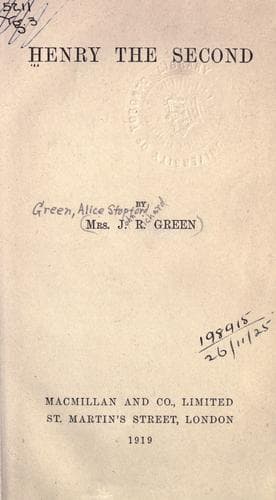
Great Britain -- History -- Henry II, 1154-1189; Henry II, King of England, 1133-1189
"He was a wise man who said, 'Let peace
be in our days'. For the sake of God choose peace, as much as in you lies
follow after peace" "The voice of the people is the voice of God," he
argued in proposing at last that bishops and monks should sit together
for the election. "But this he said," observed the monks, "knowing the
mind of the bishops, and that they sought rather the favour of the king
than of God, as their fathers and predecessors had done, who denied
St. Anselm for Rufus, who forsook Theobald for King Stephen, who rejected
the holy martyr Thomas for King Henry." Henry, however, won the day, and
his friend and nominee, the good Bishop Baldwin of Worcester, singular for
piety and righteousness, was set in the Primate's chair. Of this
archbishop we read that "his power was so great and so formidable that no
one was equal to him in all England, and without his pleasure no one would
dare even to obey the commands of the Pope.... But," adds the irritated
chronicler, "I think that he would do nothing save at the orders of the
king, even if the Apostle Peter came to England about it."
In the opinion of anxious critics of the day, indeed, the victory which
had been almost won by Thomas seemed altogether lost after his death.
Even the monasteries, where the ecclesiastical temper was most formidable,
were forced to choose abbots and priors whom the king could trust. In its
subjection the Church was in Henry's eyes an admirable engine to serve the
uses of the governing power. One of the most important steps in the
conquest of Wales had been the forcing of the Welsh Church into obedience
to the see of Canterbury; and Henry steadily used the Welsh clergy as
instruments of his policy. His efforts to draw the Scotch Church into a
like obedience were unceasing. In Ireland he worked hard for the same
object. On the death of an Archbishop of Dublin, the Irish clergy were
summoned to Evesham, and there bidden in the king's court, after the
English fashion, to choose an Englishman, Cumin, as their archbishop.
The claims of the papacy were watched with the most jealous care. No
legate dared to land in England save at the king's express will. A
legate in Ireland who seemed to "play the Roman over them" was curtly
told by the king's officers that he must do their bidding or leave the
country. In 1184 the Pope sent to ask aid for his necessities in Rome.
A council was called to consider the matter, and Glanville urged that
if papal messengers were allowed to come through England collecting money,
it might afterwards become a custom to the injury of the kingdom. The
Council decided that the only tolerable solution of the difficulty was for
the king to send whatever he liked to the Pope as a gift from himself, and
to accept afterwards from them compensation for what he might have given.
Public-domain text, read in full here on John Shaqi.
Reviews
Reviews
No reviews yet
Be the first to share your thoughts on this work.
Elsewhere in the archive
Join the Discussion
Join the discussion
Sign in to leave a comment or review.
Sign InorCreate an account