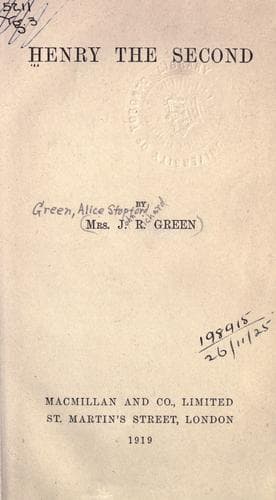
Great Britain -- History -- Henry II, 1154-1189; Henry II, King of England, 1133-1189
When in 1152 Stephen sought to have his son
Eustace anointed king, Thomas was sent to Rome, and by his skilful plea
that the papal claims had not been duly recognized in Stephen's scheme
he induced the Pope to forbid the coronation. In his first political act
therefore he definitely took his place not only as an adherent of the
Angevin claim, but as a resolute asserter of papal and ecclesiastical
rights. At his return favours were poured out upon him. While in the
lowest grade of orders, not yet a deacon, various livings and prebends
fell to his lot. A fortnight before Stephen's death Theobald ordained
him deacon, and gave him the archdeaconry of Canterbury, the first place
in the English Church after the bishops and abbots; and he must have
taken part under the Primate in the work of governing the kingdom until
Henry's arrival. The archbishop was above all anxious to secure in the
councils of the new king the due influence not only of the Church, but
of the new school of the canon lawyers who were so profoundly modifying
the Church. He saw in Thomas the fittest instrument to carryout his
plans; and by his influence the archdeacon of Canterbury found himself,
a week after the coronation of Henry, the king's chancellor.
Thomas was now thirty-eight; Theobald, Nigel, and Leicester were all old
men, and the young king of twenty-two must have seemed a mere boy to his
new counsellors. The Empress had been left in Normandy to avoid the
revival of old quarrels. Hated in England for her proud contempt of the
burgher, her scorn of the churchman, her insolence to her adherents, she
won in Normandy a fairer fame, as "a woman of excellent disposition,
kind to all, bountiful in almsgiving, the friend of religion, of honest
life." The political activity of Queen Eleanor was brought to an abrupt
close by her marriage. In Henry she found a master very different from
Louis of France, and her enforced withdrawal from public affairs during
her husband's life contrasts strangely, not only with her former career,
but with the energy which, when the heavy yoke was taken off her neck,
she displayed as an old woman of nearly seventy during the reign of her
son. Henry, in fact, stood alone among his new people. No debt of
gratitude, no ties of friendship, bound the king to the lords whose aims
he had first learned to know at Wallingford. The great barons who
thronged round him in his court had all been rebels; the younger among
them had never known what order, government, or loyalty meant. The Church
was hesitating and timorous. To the people he was an utter stranger,
unable even to speak their tongue. But from the first Henry took his
place as absolute master and leader. "A strict regard to justice was
apparent in him, and at the very outset he bore the appearance of a
great prince."
Public-domain text, read in full here on John Shaqi.
Reviews
Reviews
No reviews yet
Be the first to share your thoughts on this work.
Join the Discussion
Join the discussion
Sign in to leave a comment or review.
Sign InorCreate an account