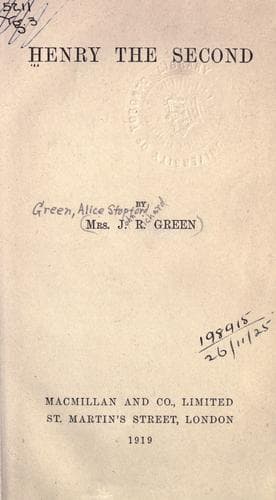
Great Britain -- History -- Henry II, 1154-1189; Henry II, King of England, 1133-1189
We see everywhere, in fact, signs of the great contest which in one form
or another runs through the whole of the twelfth century, and gives its
main interest in our eyes to the English history of the time,--the
struggle between the iron organization of medieval feudalism and those
nascent forces of modern civilization which were fated in the end to
shatter and supersede it. In spite of the cry of lamentation which the
chroniclers carry down to us over the misery of a land stricken by plague
and famine and rapine, it is still plain that even through the terrible
years of Stephen's reign England had its share in the universal movement
by which the squalor and misery of the Middle Ages were giving place to a
larger activity and a better order of things A class unknown before was
fast growing into power,--the middle class of burghers and traders, who
desired above all things order, and hated above all things the medieval
enemy of order, the feudal lord. Merchant and cultivator and wool-grower
found better work ready to their hand than fighting, and the appearance
of mercenary soldiers marked everywhere the development of peaceful
industries. Amid all the confusion of civil war the industrial activities
of the country had developed with bewildering rapidity; while knights and
barons led their foreign hirelings to mutual slaughter, monks and canons
were raising their religious houses in all the waste places of the land,
and silently laying the foundations of English enterprise and English
commerce. To the great body of the Benedictines and the Cluniacs were
added in the middle of the twelfth century the Cistercians, who founded
their houses among the desolate moorlands of Yorkshire in solitary places
which had known no inhabitants since the Conqueror's ravages, or among
the swamps of Lincolnshire. A hundred and fifteen monasteries were built
during the nineteen years of Stephen's reign, more than had been founded
in the whole previous century; a hundred and thirteen were added to these
during the reign of Henry. In half a century sixty-four religious houses
were built in Yorkshire and Lincolnshire alone. Monastery and priory, in
which the decorated Romanesque was giving way to the first-pointed
architecture, towered above the wretched mud-hovels in which the whole of
the population below the class of barons crowded; their churches were
distinguished by the rare and novel luxury of glass windows, which, as
they caught the red light of the setting sun, startled the peasant with
omens of coming ill. Multitudes of men were busied in raising the vast
pile of buildings which made up a religious house,--cloisters, dormitories,
chapels, hospitals, granaries, barns, storehouses, whose foundations when
all else is gone still show in the rugged surface of some modern field.
Regular and secular clergy were alike spurred on in their work by jealous
rivalry. Archbishop Roger of York was at the opening of Henry's reign
Public-domain text, read in full here on John Shaqi.
Reviews
Reviews
No reviews yet
Be the first to share your thoughts on this work.
Join the Discussion
Join the discussion
Sign in to leave a comment or review.
Sign InorCreate an account