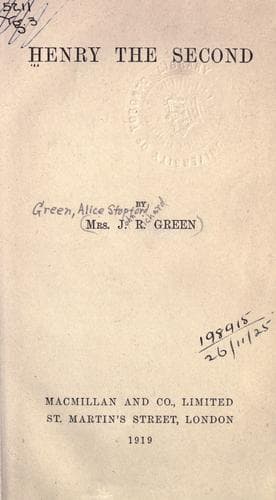
Great Britain -- History -- Henry II, 1154-1189; Henry II, King of England, 1133-1189
But if an era of industrial activity had opened, the new intellectual
impulse of the time was yet more striking. Great forces had everywhere
worked together under the one name of the Church: the ecclesiastical
organization which was represented in Rome, in the Episcopate, and in the
Canon law; the democratic monachism; the intellectual temper with its
pursuit of pure knowledge; the religious mystical spirit which was
included in all the rest and yet separate from them. But other elements
than these were at work in the twelfth century,--the literary and historic
movement, the legal revival, the new scepticism, the spirit of wide
imperialism, the romantic impulse. Education had up to this time been
wholly undertaken by the Church. The work of teaching had been one of the
main objects of the cathedral; the school and its chancellor were as
essential parts of the foundation as dean or precentor. No rivals to the
cathedral schools existed save those of the monasteries, and education
naturally bore the impress given to it in these great institutions;
profane learning was only valued so far as it could be used to illustrate
the Bible, and the ordinary teaching was almost wholly founded on four or
five authors, who wrote when the struggle of the Empire against the
barbarians was almost over, and who represented the last efforts of a
learning which was ready to vanish. The monastic libraries show how
narrow was the range of reading. The great monastery of Bec had about
fifty books. At Canterbury the library of Christ Church, which a century
later possessed seven hundred volumes, had at this time but a hundred and
fifty. Its single Greek work was a grammar; and if it could boast of a
copy of the Institutes of Justinian, it did not yet possess a single book
of civil law, not even Gratian's _Decretum_. The age of Universities,
however, had now begun, and English scholars went abroad in numbers to
study law at Bologna and the Italian universities, or to learn philosophy
and the arts at Paris, or at some of the less costly schools in Gaul. On
all sides they met with the stir of political and religious speculation.
The crusades and the intercourse with the East had broken down the
boundaries between Christian and Mohammedan thought; the Jews were
teaching science and medicine, and had just brought from the East the
philosophy of Aristotle. France struck the first note of a new literature
in her chronicles, her national poems, and the songs of her troubadours.
All Paris was ringing with the struggle of Abelard and St. Bernard. At
its university Peter Lombard was preparing to publish his _Sentences_,
which were to form the framework for the dogmatic theology of centuries
to come. New theories of liberty were quickened by classical studies
which made men familiar with the heroes of Greece and Rome. Abelard's
disciple, Arnold of Brescia, was preaching his theory of political and
religious freedom; civil government was to return to the old republican
Public-domain text, read in full here on John Shaqi.
Reviews
Reviews
No reviews yet
Be the first to share your thoughts on this work.
Join the Discussion
Join the discussion
Sign in to leave a comment or review.
Sign InorCreate an account