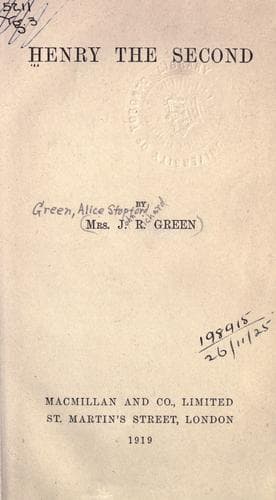
Great Britain -- History -- Henry II, 1154-1189; Henry II, King of England, 1133-1189
Henry began his work of reorganization by taking up the work which his
grandfather had begun--that of replacing the mere arbitrary power of the
sovereign by a uniform system of administration, and bringing into order
the various conflicting authorities which had been handed down from
ancient times, royal courts and manor courts, church courts, shire
courts, hundred courts, forest courts, and local courts in special
franchises, with all their inextricable confusion of law and custom and
procedure. Under Henry I. two courts, the _Exchequer_ and the _Curia
Regis_, had control of all the financial and judicial business of the
kingdom. The Exchequer filled a far more important place in the national
life than the Curia Regis, for the power of the king was simply measured
by the state of the treasury, when wars began to be fought by mercenaries,
and justice to be administered by paid officials. The court had to keep a
careful watch over the provincial accounts, over the moneys received from
the king's domains, and the fines from the local courts. It had to
regulate changes in the mode of payment as the use of money gradually
replaced the custom of payments in kind. It had to watch alterations in
the ownership and cultivation of land, to modify the settlement of
Doomsday Book so as to meet new conditions, and to make new distribution
of taxes. There was no class of questions concerning property in the most
remote way which might not be brought before its judges for decision.
Twice a year the officers of the royal household, the Chancellor,
Treasurer, two Chamberlains, Constable, and Marshal, with a few barons
chosen from their knowledge of the law, sat with the Justiciar at their
head, as "Barons of the Exchequer" in the palace at Westminster, round
the table covered with its "chequered" cloth from which they took their
name. In one chamber, the Exchequer of Account, the "Barons" received the
reports of the sheriffs from every county, and fixed the sums to be
levied. In a second chamber, the Exchequer of Receipt, the sheriff or
tax-farmer paid in his dues and took his receipts. The accounts were
carefully entered on the treasurer's roll, which was called from its
shape the Great Roll of the Pipe, and which may still be seen in our
Record Office; the chancellor kept a duplicate of this, known as the Roll
of the Chancery; and an officer of the king registered in a third Roll
matters of any special importance. Before the death of Henry I. the vast
amount and the complexity of business in the Exchequer Court made it
impossible that it should any longer be carried on wholly in London. The
"Barons" began to travel as itinerant judges through the country; as the
king's special officers they held courts in the provinces, where difficult
local questions were tried and decided on the spot. So important did the
work of finance become that the study of the Exchequer is in effect the
key to English history at this time. It was not from any philosophic love
Public-domain text, read in full here on John Shaqi.
Reviews
Reviews
No reviews yet
Be the first to share your thoughts on this work.
Join the Discussion
Join the discussion
Sign in to leave a comment or review.
Sign InorCreate an account