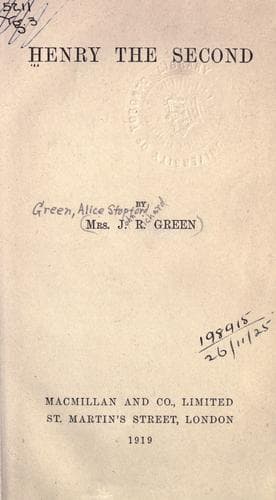
Great Britain -- History -- Henry II, 1154-1189; Henry II, King of England, 1133-1189
The reorganization of these courts was fast completed under Henry's great
justiciar, De Lucy, and the chancellor Thomas. The next few years show an
amount of work done in every department of government which is simply
astonishing. The clerks of the Exchequer took up the accounts and began
once more regular entries in the Pipe Roll; plans of taxation were
devised to fill the empty hoard, and to check the misery and tyranny
under which the tax payers groaned. The king ordered a new coinage which
should establish a uniform system of money over the whole land. As late
as the reign of Henry I. the dues were paid in kind, and the sheriffs
took their receipts for honey, fowls, eggs, corn, wax, wool, beer, oxen,
dogs, or hawks. When, by Henry's orders, all payments were first made in
coin to the Exchequer, the immediate convenience was great, but the state
of the coinage made the change tell heavily against the crown. It was
impossible to adulterate dues in kind; it was easy to debase the coin
when they were paid in money, and that money received by weight, whether
it were coin from the royal mints, or the local coinages that had
continued from the time of the early English kingdoms, or debased money
from the private mints of the barons. Roger of Salisbury, in fact, when
placed at the head of the Exchequer, found a great difference between the
weight and the actual value of the coin received. He fell back on a
simple expedient; in many places there had been a provision as old at
least as Doomsday, which enacted that the money weighed out for town-geld
should if needful be tested by re-melting. The treasurer extended this to
the whole system of the Exchequer. He ordered that all money brought to
the Exchequer should itself be tested, and the difference between its
weight and real value paid by the sheriff who brought it. The burden thus
fell on the country, for the sheriff would of course protect himself as
far as he could by exacting the same tests on all sums paid to him. If
the pound was worth but ten shillings in the market, no doubt the sheriff
only took it for ten shillings in his court. Practically each tax, each
due, must have been at least doubled, and the sheriff himself was at the
mercy of the Exchequer moneyers. There was but one way to remedy the
evil, by securing the purity of the coin, and twice during his reign
Henry made this his special care.
Public-domain text, read in full here on John Shaqi.
Reviews
Reviews
No reviews yet
Be the first to share your thoughts on this work.
Join the Discussion
Join the discussion
Sign in to leave a comment or review.
Sign InorCreate an account