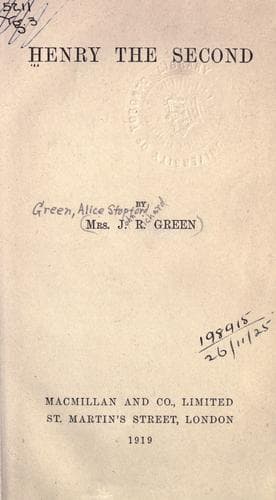
Great Britain -- History -- Henry II, 1154-1189; Henry II, King of England, 1133-1189
The Constitutions of Clarendon two years before had lain down the
principles which were to regulate the relations in England of Church and
State. The Assize of Clarendon laid down the principles on which the
administration of justice was to be carried out. Just as Henry had
undertaken to bring Church courts and Church law under the king's
control, so now he aimed at bringing all local and rival jurisdictions
whatever into the same obedience. In form the new law was simple enough.
It consisted of twenty-two articles which were drawn up for the use of
the judges who were about to make their circuits of the provinces. The
first articles described the manner in which criminals were to be
"presented" before the justices or sheriff. The accusation was to be
made by "juries," composed of twelve men of the hundred and four men of
the township; the "presentment" of a criminal by a jury such as this
practically implied that the man was held guilty by the public report of
his own neighbourhood, and he was therefore forbidden such chance of
escape as compurgation or the less dangerous forms of ordeal might have
afforded, and was sent to the almost certain condemnation of the ordeal
by water; if by some rare fortune he should escape from this alive he
was banished from the kingdom as a man of evil reputation. All freemen
were ordered to attend the courts held by the justices. The judges were
given power to enter on all estates of the nobles, to see that the men
of the manor were duly enrolled under the system of "frank-pledge," in
groups of ten men bound to answer for one another as "pledges" for all
purposes of police. Strict rules were made to prevent the possible
escape of criminals. The sheriffs were ordered to aid one another in
carrying the hue and cry after them from one country to another; no
"liberty" or "honour" might harbour a malefactor against the king's
officers; sheriffs were to give to the justices in writing the names of
all fugitives, so that they might be sought through all England;
everywhere jails, in which doubtful strangers or suspected rogues might
be shut up for safe keeping in case the "hue and cry" should be raised
after them, were to be made or repaired with wood from the king's or the
nearest landowner's domains; no man might entertain a stranger for whom
he would not be answerable before the justices; the old English law was
again repeated in the very words of ancient times, that none might take
into his house a waif or wanderer for more than one night unless he or
his horse were sick; and if he tarried longer he must be kept until he
were redeemed by his lord or could give safe pledges; no religious house
might receive any of the mean people into their body without good
testimony as to character unless he were sick unto death; and heretics
were to be treated as outlaws. These last indeed were not very plentiful
in England, and the over-anxious legislators seem only to have had in
Public-domain text, read in full here on John Shaqi.
Reviews
Reviews
No reviews yet
Be the first to share your thoughts on this work.
Elsewhere in the archive
Join the Discussion
Join the discussion
Sign in to leave a comment or review.
Sign InorCreate an account