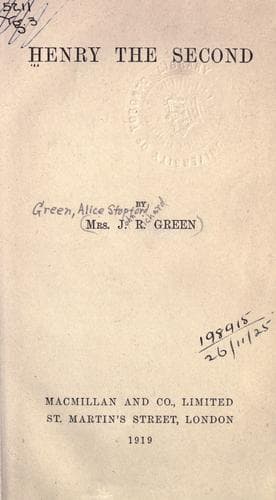
Great Britain -- History -- Henry II, 1154-1189; Henry II, King of England, 1133-1189
view a little band of German preachers, who had converted one woman, and
who had themselves at a late council at Oxford been branded, flogged,
and driven out half-naked, so that there was by this time probably not
one who had not perished in the cold.
Such was the series of regulations that opened the long course of
reforms by which English law has been built up. Two judges were sent
during the next spring and summer through the whole of England. The
following year there was a survey of the forests, and in 1168 another
circuit of the shires was made by the barons of the Exchequer. Year by
year with unbroken regularity the terrible visitation of the country by
the justices went on. The wealth of the luckless people poured into the
king's treasury; the busy secretaries recorded in the Rolls a mass of
profits unknown to the accounts of earlier days. The great barons who
presided over the Shire courts found themselves practically robbed of
power and influence. The ordinary courts fell into insignificance beside
those summoned by the king's judges, thronged as they were with the
crowd of rich and poor, trembling at the penalty of a ruinous fine for
non-attendance or full of a newly-kindled hope of justice. Important
cases were more and more withdrawn from the sheriffs and given to the
justices. They entered the estates of the nobles, even the franchises,
liberties, and manors which had been freed from the old courts of the
shire or hundred; they reviewed their decisions and interfered with their
judgments. It is true that the system established in principle was but
gradually carried into effect, and the people long suffered the tyranny
of lords who maintained their own prisons. Half a century later we find
sturdy barons setting up their tumbrils and gallows. In the reign of
Edward I. there were still thirty-five private gallows in Berkshire
alone, and when one of them was by chance or age broken down, and the
people refused to set it up again, the baron could still make shift with
the nearest oak. But as a system of government, feudalism was doomed from
the day of Henry's Assize, and only dragged out a lingering existence
till the legislation of Edward I. dealt it a final blow.
Public-domain text, read in full here on John Shaqi.
Reviews
Reviews
No reviews yet
Be the first to share your thoughts on this work.
Elsewhere in the archive
Join the Discussion
Join the discussion
Sign in to leave a comment or review.
Sign InorCreate an account