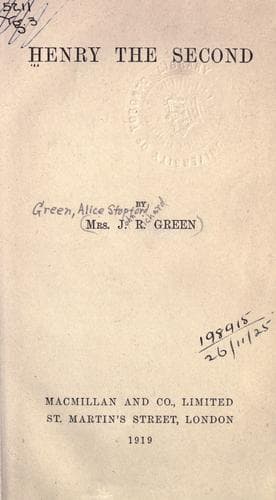
Great Britain -- History -- Henry II, 1154-1189; Henry II, King of England, 1133-1189
There was, in fact, in all Christendom no such system of government or
of justice as that which Henry's reforms built up. The king became the
fountain of law in a way till then unknown. The later jealousy of the
royal power which grew up with the advance of industrial activity, with
the growth of public opinion and of its means of expressing itself, with
the development of national experience and national self-dependence, had
no place in Henry's days, and had indeed no reason for existence. The
strife for the abolition of privileges which in the nineteenth century
was waged by the people was in the twelfth century waged by the Crown.
In that time, if in no other, the assertion of the supreme authority of
the king meant the assertion of the supreme authority of a common law;
and there was, in fact, no country in Europe where the whole body of the
baronage and of the clergy was so early and so completely brought into
bondage to the law of the land. Since all courts were royal courts,
since all law was royal law, since no justice was known but his, and its
conduct lay wholly in the hands of his trained servants, there was no
reason for the king to look with jealousy on the authority exercised by
the law over any of his officers or servants. It may possibly be due to
this fact that in England alone, of all countries in the world, the
police, the civil servants, the soldiers, are tried in the same courts
and by the same code as any private citizen; and that in England and
lands settled by English peoples alone the Common law still remains the
ultimate and only appeal for every subject of the realm.
Public-domain text, read in full here on John Shaqi.
Reviews
Reviews
No reviews yet
Be the first to share your thoughts on this work.
Elsewhere in the archive
Join the Discussion
Join the discussion
Sign in to leave a comment or review.
Sign InorCreate an account