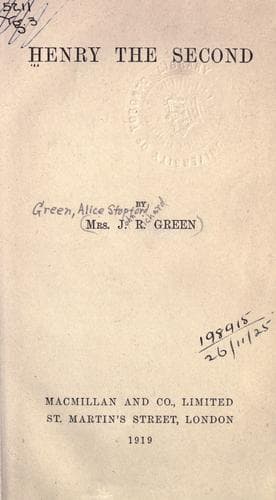
Great Britain -- History -- Henry II, 1154-1189; Henry II, King of England, 1133-1189
Oppression and extortion had doubtless been well known before, when the
sheriff carried on the administration of the law side by side with the
lucrative business of "farming the shires;" but it was at least an
irregular and uncertain oppression. The sheriff might himself at any
moment share the fate of one of his own victims and a more merciful man
stand in his place; in any case bribes were not unavailing, and there
was still an appeal to the king's justice. But against the new system
there was no appeal; it was orderly, methodical, unrelenting; it was
backed by the whole force of the kingdom; it overlooked nothing; it
forgot nothing; it was comparatively incorruptible. The lesser courts,
with their old clumsy procedure, were at a hopeless disadvantage before
the professional judges, who could use all the new legal methods. If a
man suffered under these there was none to plead his cause, for in all
the country there was not a single trained lawyer save those in the
king's service. However we who look back from the safe distance of seven
hundred years may see with clearer vision the great work which was done
by Henry's Assize, in its own day it was far from being a welcome
institution to our unhappy forefathers. There was scarcely a class in
the country which did not find itself aggrieved as the king waged war
with the claims of "privilege" to stand above right and justice and truth.
But all resistance of turbulent and discontented factions was vain.
The great justiciars at the head of the legal administration, De
Lucy and Glanville, steadily carried out the new code, and a body of
lawyers was trained under them which formed a class wholly unknown
elsewhere in Europe. Instead of arbitrary and inflicting decisions,
varying in every hundred and every franchise according to the fashion of
the district, the judges of the Exchequer or Curia Regis declared
judgments which were governed by certain general principles. The
traditions of the great administrators of Henry's Court were handed down
through the troubled reigns of his sons; and the whole of the later
Common law is practically based on the decisions of two judges whose
work was finished within fifty years of Henry's death, and whose labours
formed the materials from which in 1260 Bracton drew up the greatest
work ever written on English law.
Public-domain text, read in full here on John Shaqi.
Reviews
Reviews
No reviews yet
Be the first to share your thoughts on this work.
Elsewhere in the archive
Join the Discussion
Join the discussion
Sign in to leave a comment or review.
Sign InorCreate an account