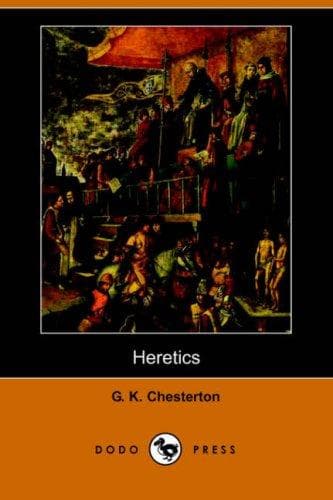
Apologetics; Chesterton, G. K. (Gilbert Keith), 1874-1936
HERETICS
by
Gilbert K. Chesterton
“To My Father”
Source
Heretics was copyrighted in 1905 by the John Lane Company. This
electronic text is derived from the twelfth (1919) edition published by
the John Lane Company of New York City and printed by the Plimpton
Press of Norwood, Massachusetts. The text carefully follows that of
the published edition (including British spelling).
The Author
Gilbert Keith Chesterton was born in London, England on the 29th of
May, 1874. Though he considered himself a mere “rollicking
journalist,” he was actually a prolific and gifted writer in virtually
every area of literature. A man of strong opinions and enormously
talented at defending them, his exuberant personality nevertheless
allowed him to maintain warm friendships with people—such as George
Bernard Shaw and H. G. Wells—with whom he vehemently disagreed.
Chesterton had no difficulty standing up for what he believed. He was
one of the few journalists to oppose the Boer War. His 1922 “Eugenics
and Other Evils” attacked what was at that time the most progressive of
all ideas, the idea that the human race could and should breed a
superior version of itself. In the Nazi experience, history
demonstrated the wisdom of his once “reactionary” views.
His poetry runs the gamut from the comic 1908 “On Running After One’s
Hat” to dark and serious ballads. During the dark days of 1940, when
Britain stood virtually alone against the armed might of Nazi Germany,
these lines from his 1911 Ballad of the White Horse were often quoted:
I tell you naught for your comfort,
Yea, naught for your desire,
Save that the sky grows darker yet
And the sea rises higher.
Though not written for a scholarly audience, his biographies of authors
and historical figures like Charles Dickens and St. Francis of Assisi
often contain brilliant insights into their subjects. His Father Brown
mystery stories, written between 1911 and 1936, are still being read
and adapted for television.
His politics fitted with his deep distrust of concentrated wealth and
power of any sort. Along with his friend Hilaire Belloc and in books
like the 1910 “What’s Wrong with the World” he advocated a view called
“Distributionism” that was best summed up by his expression that every
man ought to be allowed to own “three acres and a cow.” Though not known
as a political thinker, his political influence has circled the world.
Some see in him the father of the “small is beautiful” movement and a
newspaper article by him is credited with provoking Gandhi to seek a
“genuine” nationalism for India rather than one that imitated the
British.
Public-domain text, read in full here on John Shaqi.
Reviews
Reviews
No reviews yet
Be the first to share your thoughts on this work.
Join the Discussion
Join the discussion
Sign in to leave a comment or review.
Sign InorCreate an account