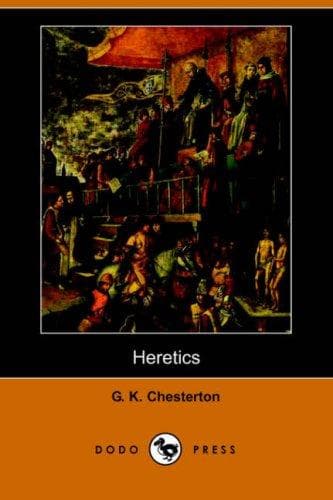
Apologetics; Chesterton, G. K. (Gilbert Keith), 1874-1936
A great silent collapse, an enormous unspoken disappointment, has in
our time fallen on our Northern civilization. All previous ages have
sweated and been crucified in an attempt to realize what is really the
right life, what was really the good man. A definite part of the modern
world has come beyond question to the conclusion that there is no
answer to these questions, that the most that we can do is to set up a
few notice-boards at places of obvious danger, to warn men, for
instance, against drinking themselves to death, or ignoring the mere
existence of their neighbours. Ibsen is the first to return from the
baffled hunt to bring us the tidings of great failure.
Every one of the popular modern phrases and ideals is a dodge in order
to shirk the problem of what is good. We are fond of talking about
“liberty”; that, as we talk of it, is a dodge to avoid discussing what
is good. We are fond of talking about “progress”; that is a dodge to
avoid discussing what is good. We are fond of talking about
“education”; that is a dodge to avoid discussing what is good. The
modern man says, “Let us leave all these arbitrary standards and
embrace liberty.” This is, logically rendered, “Let us not decide what
is good, but let it be considered good not to decide it.” He says,
“Away with your old moral formulae; I am for progress.” This, logically
stated, means, “Let us not settle what is good; but let us settle
whether we are getting more of it.” He says, “Neither in religion nor
morality, my friend, lie the hopes of the race, but in education.”
This, clearly expressed, means, “We cannot decide what is good, but let
us give it to our children.”
Public-domain text, read in full here on John Shaqi.
Reviews
Reviews
No reviews yet
Be the first to share your thoughts on this work.
Join the Discussion
Join the discussion
Sign in to leave a comment or review.
Sign InorCreate an account