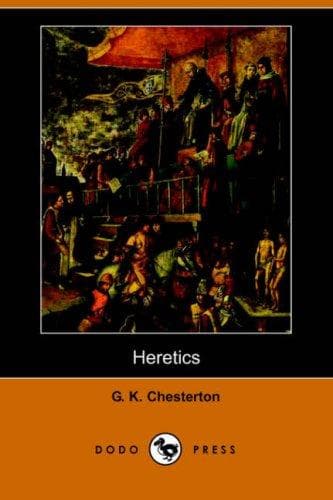
Apologetics; Chesterton, G. K. (Gilbert Keith), 1874-1936
We may jump upon a child’s rocking-horse for a joke. But
we are glad that the carpenter did not leave the legs of it unglued for
a joke. So far from having merely preached that a soldier cleaning his
side-arm is to be adored because he is military, Kipling at his best
and clearest has preached that the baker baking loaves and the tailor
cutting coats is as military as anybody.
Being devoted to this multitudinous vision of duty, Mr. Kipling is
naturally a cosmopolitan. He happens to find his examples in the
British Empire, but almost any other empire would do as well, or,
indeed, any other highly civilized country. That which he admires in
the British army he would find even more apparent in the German army;
that which he desires in the British police he would find flourishing,
in the French police. The ideal of discipline is not the whole of life,
but it is spread over the whole of the world. And the worship of it
tends to confirm in Mr. Kipling a certain note of worldly wisdom, of
the experience of the wanderer, which is one of the genuine charms of
his best work.
The great gap in his mind is what may be roughly called the lack of
patriotism—that is to say, he lacks altogether the faculty of
attaching himself to any cause or community finally and tragically; for
all finality must be tragic. He admires England, but he does not love
her; for we admire things with reasons, but love them without reasons.
He admires England because she is strong, not because she is English.
There is no harshness in saying this, for, to do him justice, he avows
it with his usual picturesque candour. In a very interesting poem, he
says that—
“If England was what England seems”
—that is, weak and inefficient; if England were not what (as he
believes) she is—that is, powerful and practical—
“How quick we’d chuck ’er! But she ain’t!”
He admits, that is, that his devotion is the result of a criticism, and
this is quite enough to put it in another category altogether from the
patriotism of the Boers, whom he hounded down in South Africa. In
speaking of the really patriotic peoples, such as the Irish, he has
some difficulty in keeping a shrill irritation out of his language. The
frame of mind which he really describes with beauty and nobility is the
frame of mind of the cosmopolitan man who has seen men and cities.
“For to admire and for to see,
For to be’old this world so wide.”
He is a perfect master of that light melancholy with which a man looks
back on having been the citizen of many communities, of that light
melancholy with which a man looks back on having been the lover of many
women. He is the philanderer of the nations. But a man may have learnt
much about women in flirtations, and still be ignorant of first love; a
man may have known as many lands as Ulysses, and still be ignorant of
patriotism.
Public-domain text, read in full here on John Shaqi.
Reviews
Reviews
No reviews yet
Be the first to share your thoughts on this work.
Join the Discussion
Join the discussion
Sign in to leave a comment or review.
Sign InorCreate an account