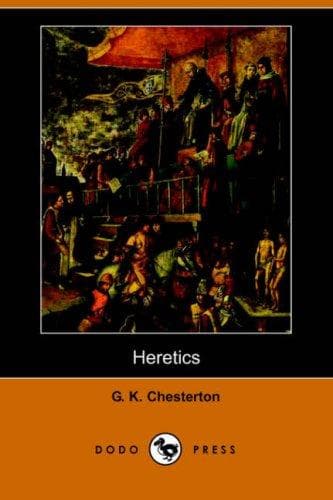
Apologetics; Chesterton, G. K. (Gilbert Keith), 1874-1936
But there are some people, nevertheless—and I am one of them—who
think that the most practical and important thing about a man is still
his view of the universe. We think that for a landlady considering a
lodger, it is important to know his income, but still more important to
know his philosophy. We think that for a general about to fight an
enemy, it is important to know the enemy’s numbers, but still more
important to know the enemy’s philosophy. We think the question is not
whether the theory of the cosmos affects matters, but whether in the
long run, anything else affects them. In the fifteenth century men
cross-examined and tormented a man because he preached some immoral
attitude; in the nineteenth century we feted and flattered Oscar Wilde
because he preached such an attitude, and then broke his heart in penal
servitude because he carried it out. It may be a question which of the
two methods was the more cruel; there can be no kind of question which
was the more ludicrous. The age of the Inquisition has not at least the
disgrace of having produced a society which made an idol of the very
same man for preaching the very same things which it made him a convict
for practising.
Now, in our time, philosophy or religion, our theory, that is, about
ultimate things, has been driven out, more or less simultaneously, from
two fields which it used to occupy. General ideals used to dominate
literature. They have been driven out by the cry of “art for art’s
sake.” General ideals used to dominate politics. They have been driven
out by the cry of “efficiency,” which may roughly be translated as
“politics for politics’ sake.” Persistently for the last twenty years
the ideals of order or liberty have dwindled in our books; the
ambitions of wit and eloquence have dwindled in our parliaments.
Literature has purposely become less political; politics have purposely
become less literary. General theories of the relation of things have
thus been extruded from both; and we are in a position to ask, “What
have we gained or lost by this extrusion? Is literature better, is
politics better, for having discarded the moralist and the philosopher?”
Public-domain text, read in full here on John Shaqi.
Reviews
Reviews
No reviews yet
Be the first to share your thoughts on this work.
Join the Discussion
Join the discussion
Sign in to leave a comment or review.
Sign InorCreate an account